Wednesday, July 31, 2013
LONESOME (Paul Fejos, 1928)
A major flaw with modern audiences' perception of film is the overemphasis on story and audiences' fixation of it even when it is unimportant and only aids a theme. Some films can have great visuals, yet not hold up at all because of the lack of story and the fact that it attempts to make the story important and a true fixture of the film, like a "traditional" film. A film like this would be Tarsem's The Fall, a shallow, stupid film with admittedly lovely issues.
Two late silent era films are often criticized today for their lack of an interesting story, relying on old cliches of love. The first is Sunrise, which is certainly the more well-known of the two, but the second is Paul Fejos's often forgotten Lonesome. Lonesome was lost for many years, and could be criticized for its run-of-the-mill plot- two lonely individuals meet and fall in love, only by knowing each others first name, and soon are separated. The plot doesn't do much, but Lonesome is still a spectacle to behold today, with its unconventional structure, awesome tinting and hand-painting, and its odd use of sound and dialogue.
Paul Fejos, a European who was a doctor and anthropologist as well as a filmmaker, builds the atmosphere of Lonesome by first dissecting New York city at a whole. Much of the film serves as a New York city symphony, which was an early documentary mode, most famously seen in Veratov's Man with the Movie Camera. The first inter-title describes New York as a machine, and we soon see its inner workings through an array of shots, and a good amount of superimpositions. This graphic structure itself is interesting, and makes up most of the film. A good portion of the film takes place at (presumably) Coney Island on the Fourth of July weekend, serving as an event documentary, displaying the sprawl of the city and its often dehumanizing effect. This theme aids the simple plot, and takes the weight of the theme off of the literal story.
Tinting and hand-painting of old film is a technique that still impresses to this day, as one can really appreciate the amount of hard work one puts into the process. On top of that, it just looks beautiful. Fejos changes the color of the tint on a mid-shot of the two lovers multiple times, while a great sequence shows the gentle coloring and lighting of a two lovers, alone on a bench (despite the fact that the dock is always packed besides this scene, and in fact, the lovers almost lose each other in the herd, but is empty for this one shot, which works emotionally instead of literally-rare for such an old film) adorned in yellow amongst a dark blue surrounding, again showcasing a "us and them" mentality, separating lovers from the swamp around them.
It is worth noting that Lonesome was an incredibly early sound film, I believe Universial's first, and only three or four scenes have spoken words. However, the dialogue is just bizarre, stilted, and hokey, reminding me of the great early sound parody "Tomatoes Another Day." The last sound sequence shows a confusing dialogue between the man and a cop, where the police commander speaks with sarcasm, but it is completely covert- and intended to be so, since our hero is upset. The dialogue is usually incredibly weak, but the one instance of deliberate toying with tone is an interesting direction experiment.
Lonseome is far from perfect, and it certainly makes sense why it was forgotten for so long. It is a strange, strange film which doesn't ever really know what it wants to be. However, its indecision makes it incredibly interesting and certainly worth a watch. All in all, Lonesome's oddity warrants a watch for its history and sustained entertainment value.
Labels:
Classic Film,
classic review,
early sound,
silent
Luis Bunuel Retrospective- Pt. 2- THE MEXICAN JOURNEYMAN
Luis Bunuel was specifically brought in to Mexico to be a commercial director, and ultimately was, working mainly in melodrama, yet always including a personalized surreal touch that he had perfected. To quote the Swedish mater Ingmar Bergman, "Bunuel always made Bunuel films." Bunuel's style always surfaced in one way or another, be it in dream sequences, themes, or certain images. Bunuel made the bulk of his filmography in Mexico, from La Grand Casino to Simon of the Desert.
This is the area where Bunuel receives his distinction of under appreciated and often forgotten, at least in America. Many of these films are completely unavailable in America on DVD, or at least very, very, rare. I admittedly have not even seen the bulk of them since they are just unavailable. Terrible Mexican video companies own the rights to many of the films, and utterly refuse to sell them or even release them on DVD. The subtitles often have typos, and the image is a true travesty.
Bunuel's earliest film of the period that garnered serious attention was Los Olvidados, a Bunuel-take on the neo-realist movement that was capturing world cinema. Bunuel takes his camera to the streets, using non-actors and real settings to show the plight of youths forgotten by society. Bunuel's major touch comes in the form of a dream sequence, with slow-motion feathers floating to the ground, a la Vigo's Zero du Conduit and a bloodied dead boy laughing on the ground. The sequence is truly stunning, and hides the otherwise bleak nature of the film for just a moment. Bunuel is brutal and relentless in his portrayal of poverty.
Another major film for the period is El, returning to literally examine the theme of sexual repression and obsession, showing a man who loves the very idea of a woman so much he is willing to do anything to hold onto her. The film is stacked with Bunuel's religious iconography and carries serious criticism for the Catholic church, where a priest not only refuses to help the tortured heroine, but actually rats her out to her husband. This is an early direct example of Bunuel's treatment of religious hypocrisy, which was later visited time and time again.
Again, I must lament the fact that so many of these films are unavailable, including Ensayo de un Crimen, Susana, Subida Au Cielo, and Wuthering Heights. It represents a huge blind spot in our consciousness of a great filmmaker who overcame producers to stay true to his vision. I dream that one day a company like Criterion will pick up these titles and finally do them justice.
Bunuel's most acclaimed film of the period is Nazarin, a film that is thematically similar to his well-known follow-up. Nazarin follows Father Nazzario, an idealistic and certainly good Catholic priest who risks his reputation for a prostitute and constantly battles the church. The story is a critique of the cold church and of idealism and general, yet it also parodies the story of Christ. Nazario is often mistaken as a "second coming" type figure. Two of the prostitutes follow the man to the world's end, even though he urges them against it, saying he is just a humble man. Nazario arrives at a village where a young girl is sick. The villagers urge him to perform a miracle, which he refuses, but he does pray for the girl. The next morning, the woman praise the priest, but he insists God intervened. However, Nazario is silent when the group stumbles upon a massive disaster, and is unable to help anyone, even unable to hear a woman's confession as she is fixated only on seeing her lover. The film's final image is incredibly powerful, involving intense despair and a pineapple. Although I covered what seems like a good amount, much more is in store in the film and do not wish to spoil.
The follow-up was made not in Mexico, but was instead Bunuel's return to Spain. I don't mean to exaggerate, but Viridana may be my all-time favorite film, and is, in my opinion, cinematic perfection. The story is mainly a critique of idealism, but dives in against organized religion, obsession, lust, chastity, poverty, and sensitivity. It's a truly deep and spellbinding work that follows a cold young nun as she visits her uncle. Perhaps that may not sound thrilling, but I urge anyone to watch it. I do not wish to give away a single detail of the plot explicitly. The film's message is best seen in an odd image Bunuel presents to us- a character sees a dog tied to the bottom of a cart. The character is shocked, as if the tired Dog stops moving, it will be strangled. The character attempts to convince the owner to let the dog in the cart, and when the owner refuses, the character outright buys the dog, much like what our heroine Viridiana does with the beggars. However, as out character walks away with the dog, another cart passes, which has another dog walking under it, tied to the axle. It's a hugely powerful and slightly abstract image that perfectly captures the film.
Bunuel's next film, The Exterminating Angel, made again in Mexico but attempting to look like France, offers another abstract analogy, this time taking on the ruling class directly. A dinner party, for unknown reasons, cannot leave a room. In such a simple, absurd concept, Bunuel shows us his opinion of the human lab rats that make up the upper class, stuck in the regime of parties and excess. AT the film's end, the priest and church goers in a Catholic cathedral suffer the same fate.
This period of Bunuel's career is characterized with his most accessible and straight-forward films, as they were made with the intention of profitability first and foremost. Bunuel's later career is defined by him attempting to unlearn the narrative trick of this period, creating more challenging and difficult films.
Labels:
analysis,
Bunuel,
directors,
retrospective,
spotlight
Monday, July 29, 2013
Luis Bunuel retrospective- Part 1- EARLY LIFE AND EXPERIMENTS
July 29th, 1983 (30 years ago, today) marked the death of Luis Bunuel. To some who consider themselves fans of film, this may not mean anything, while it may mean everything to some. Luis Bunuel, despite his sterling reputation (for example, They Shoot Pictures lists him as one of the three "master" directors, meaning a perfect 10, along with Howard Hawks and Alfred Hitchcock), is criminally unwatched and undervalued among the general public. Many of his films are rare and hard to find, but I'll get into that later.
Now, I have written on Bunuel much before, but now, I just don't want to republish something, which I've done on a few occasions. My writings on Bunuel earlier were academic and lengthy. Perhaps I will publish it at a later date, but for now, I will write new material. I may borrow from my previous writings, however.
Now, perhaps a little bit of background on Bunuel is needed to truly understand him. Bunuel was born in 1901 in Spain, and grew up in a religious aristocratic family, two relations which run deeply through pretty much every film he has ever done. Additionally, Bunuel admits in his (excellent) biography that he was very sexually oppressed, another constant theme. When he was eighteen, he went of to University in Madrid, where he met several creative minds that like Federico Garcia Lorca and Salvador Dali, with whom he would be closely affiliated.
Bunuel's artistic awakening came in Paris in the late 1920s. At this time, he allied with many of the surrelists, such as Max Ernst. One of the most fascinating parts of Bunuel's biography The Last Sigh is that the book works as a first-hand report of the surrealist movement, and Bunuel really dives into what the movement was in his eyes- less artistic, and more of a new system of reality which rejected everything society cherished. In Paris, Bunuel worked as an assistant for the early French silent director Jean Epstien.
In 1929, Bunuel and Dali set out to make a film with funds Bunuel secured from his mother, despite her never actually seeing the film, and never expressing any interest in doing so. The result was Un Chien Andalou, which still is Bunuel's most popular film, although it does not show off the director's skills sufficiently. Bunuel's genius was in story-telling, and Un Chien is pure non-narrative, and Bunuel stated several times that it is supposedly total nonsense. I must admit that when I was an early teenager I first heard of Bunuel through Un Chien, where he was essentially just "the guy that's not Dali."
Un Chien Andalou had an instant and massive influence, specifically for its odd structure and bizarre images, which in fact does capture much of Bunuel's essence. Perhaps one of cinema's most iconic images is the woman being held by a man (who is actually Bunuel) as we see a cloud slice through the moon. Then we see an eye sliced (where, yes, the name of this blog comes from) with plasma oozing from the slit. It's instantly memorable, as is another fantastic image, of a man weighed down by a dead donkey, a grand piano, and two perplexed priests (one of whom was Dali), which represents a recurring Bunuel theme- the strains of upper society and religion on all aspects of one's life. Dali's influence can be felt in many of the images, such as ants crawling through a man's hand. Bunuel's dreams were much more rooted in a worldly reality than Dali's, which kept him grounded and decidely unpretentious.
Next, Dali and Bunuel collaborated one more time before breaking their partnership permanently. This film was L'Age D'Or and is certainly much more Bunuel's than Dali's. The collaboration was fading quickly due to the emergence of Galla Dali, Dali's falling out with the surrealists, and that the duo simply wasn't as inspired together as they once were. The film was just over an hour long, and bore the distinction of being one of the earliest sound films made in France. The film is certainly a spiritual sequel to Un Chien and resembles it like no other part of Bunuel's filmography. Here, Bunuel revisits many of the same themes, but takes an extra blade out towards the church with the final scene, which is a reenactment of a scene from De Sade's 120 Days of Sodom with Jesus as the perverse duke. The Christ figure comforts a young girl, leads her back into the cave, and after a scream, he emerges, now without a beard. The final image is a cross adorned in scalps of women, which implies violence against woman is the trademark of church history.
Compared to Bunuel's later filmography, his first two films are unique and worth visiting, but certainly do not reflect Bunuel's filmography at all. Bunuel was so much more than chocking imagery, and I have a tough time getting some people to watch any of his films if they are familiar and dislike his trademark eye slice. L'Age D'or shocked France so much that it caused riots and was banned by the government until 1980. Bunuel fled France, not returning until the 1960s. He went to Spain, where he filmed the thirty minute Las Hurdes, financed for a minimal amount of money.
Las Hurdes receives a good amount of recognition for its status as an early documentary, and one of the earliest with such a political statement like showing the crippling poverty of regions in Spain. We see several shocking images again, but now, they are rooted within reality. We see close ups of a young girls mouth, as we hear that in a few days, the toddler will be dead. A donkey is stung to death by a hoard of bees while orchestral music and a dry narration goes forth. Bunuel again seizes an opportunity to attack a favorite target by focusing on a massive structure among this wasteland- a catholic cathedral, of course.
Las Hurdes again caused huge controversy, halting Bunuel from making any films from years to come. Bunuel fled Spain for the United States on the heels of the Spanish Civil War, where he would have certainly been viewed as a political threat subject to assassination. Bunuel landed in Los Angeles at first, living with Charlie Chaplin for some time (Chaplin allegedly used to scare his daughter, Geraldine, by telling her images from Un Chien Andalou before bedtime) and then worked at the studio. Eventually, his wife came over with his two sons, and the director moved to New York, where he was on the MoMa board before Communist ties forced him to resign. Bunuel was broke in New York with no job and no prospects, until an old friend living in Mexico contacted him with a directing opportunity. The year was 1947, and Bunuel had not been behind a camera in fifteen years, and had never even made a feature length narrative, but he accepted the job to make La Gran Calavera.
Labels:
analysis,
Bunuel,
Classic Film,
directors,
retrospective,
spotlight
FRUITVALE STATION (2013, Ryan Coogler)
Few directorial debuts have garnered as much attention as Ryan Coogler's Fruitvale Station, which won the top prize at Sundance as well as a huge amount of relevancy in the wake of the Trayvon Martin shooting. The film, which was just recently released nation-wide, tells the story of Oscar Grant, a young man who was unjustly shot by police early on New Year's Day. That is no spoiler, as the film assumes you know the story, which was national news a few years ago, and how the film markets itself as the last few hours in a man's life.
Dealing with such an intimate and real-life situation such as Oscar Grant's death requires a great amount of polished talent to make the story dramatic and interesting. Coogler just doesn't have it, although he certainly shows flashes of potential. Too often the film aims too low, and the first hour simply shows how nice of a guy Oscar Grant is. Sure, he was a drug dealer and was in prison, but he's over that! In a particularly ridiculous early scene, Grant pets a dog at a gas station, and moments later when the dog is hit by a car, we see Grant moan and cry. Coogler is prodding us to go "Look, he cried about a dog, how nice!" Coogler seems unconfident that an audience would accept a former convict as a nice guy, so he pads the film with all sorts of ridiculous scenes showing off how damn nice this guy is, bluntly telling us rather than showing anything. However, despite the weaknesses of the writer-director, Michael B. Jordan does a fairly good job, especially given his hokey material.
The cinematography is also a major issue, as Coogler and his D.P. resort to the current mark of current low-budget cinema- sloppy shallow focus. Fruitvale may be a prime example of the aestetic, where the D.P. shoots mainly in closeup and occasionally shifts focus for no reason (well, his reasoning is to show the "distorted nature of the scene", but really, it just looks cool. It's typically totally unneeded.) Nichol's Mud is another prime example of poor usage of this technique, while Ciranfrance's A Place Beyond the Pines uses it exceptionally well, shooting characters behind patterns and structures, letting the textures and not the open area be blurred.
After an hour of Lifetime Movie-grade fluff, the film slowly grows into its own during a short, energetic scene of Oscar and his friends having a good time. The film shows a more realistic side of Oscar, as he's not helping people at every turn and talking to old women playing with flowers.
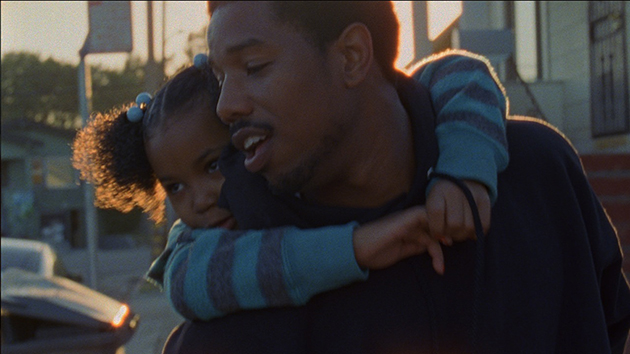
The climax, where Oscar is shot, also carries a certain energy to it, and is well-shot and acted. Here, the film is at its absolute strongest. The sequence is heavily indebted to Spike Lee's Do The Right Thing, which still stands on its own. Afterward, we are truly kept in suspense through realistic operation scenes, but ultimately, the film whithers back to its sentimental roots. After a long speech by his mother that any viewer could see coming forty minutes ago, we see Oscar playing with his daughter again to an overexposed film. Of course. It's such a typical ending that it robs any emotional climb the last twenty minutes built.
Fruitvale, quite simply, is poor melodrama which refuses to let its characters breathe and its audience watch on its own. The audience is taken by the hand and told directly how nice Oscar was despite his past, as we could never get that without seeing him cry over dead dogs, Grandmas picking flowers, sneaking his daughter fruitsnacks, and weepy mom-alogues. Despite good performance and a few bursts of creative potential, Fruitvale Station is a melodramatic film that insults its audience by hand-feeding them every detail, robbing any possibility of true drama and intrigue.
Friday, July 26, 2013
SPING BREAKERS (Harmony Korine, 2013)
Harmony Korine, the low budgeted, inventive, and likely crazy auteur known for semi-experimental films such as Julien Donkey-Boy, Gummo, Mr. Lonely and Trash Humpers shocked the film community by announcing Spring Breakers, utilizing several former Disney stars and documenting a Spring Break party lifestyle.
Even though it still had a small budget, the film drew in many high-profile stars, such as former Disney products Selena Gomez (who still has ties with the mouse, so plays the moral center of the group), and Vanessa Hudgens, as well as ABC Family star Ashley Benson. The girls, along with Rachel Corine, are "typical" college girls who declare that they need a break from getting drunk and high at school by getting drunk and high in Florida, and to raise funds, rob a restaurant.
Korine already is presenting something atypical and unexpected, even to those who think they know what they are getting in to. The structure itself is especially bizarre, since the plot focuses on the group on break at first, before even introducing the main catalyst of the plot, Alien.
The editing style is particularly noteworthy, as it often functions in an upfront and direct manner. Honestly, it is hard for me to explain in words what Korine does, but I can compare it to Dennis Hopper's work on Easy Rider, where he flashes several images to bridge scenes, and in one instance, shows an event well into the future. Korine plays with the chronology frequently, for example, showing a character bleeding and crying from a gunshot wound before the shot is even fired.
The film at a whole is just very strange, starting from its story and language. The film operates very symbolically and covertly, often color coding the information and working in layers of meaning. However, sometimes the story can be just much too blunt and straightforward by how absurd the images and characters are supposed to be, yet it doesn't give the sense it even know it.
The film's biggest star arrives nearly halfway through the film in James Franco, playing a crazy drug dealer, Alien, who very well could be a stand in for Korine himself, injecting a level of chaos and insanity into the already bizarre adventures of our main characters while we can practically hear Harmony Korine cackle off screen.
Alien certainly brings the issue of good and evil into our minds, but why? We already know what the girls are capable of after the early robbery. Perhaps we are meant to see how low they went, and how some of them will attempt to escpae, drawing out of the chaos. Morality? Injury? Both play a role in some of the girls' insistance to stop the experiment. The film represents how different people react when a situation is escalated to absurd extremes, yet is less of a character piece than it is a study of the "party" mindset that thrives in many youths. Spring Breakers can sometime be a bit meandering and sometimes too spoken-out and obvious, but it is truly beautifully and originally shot, and offers up a fresh take on college films, in a way that certainly isn't intended for its subjects.
Wednesday, July 24, 2013
The growing distance between film and television
Television, with the birth of original, in-depth programming such as Breaking Bad, has been seen as a more artistic and in depth story telling medium than ever before. Content is riskier and freer than what broadcast television could ever offer. Shows can now tell completely inter-connected stories without trying to bring in new viewers week after week. Now, with the internet, viewers can get caught up to date on their own time.
Some even argue that television is the new place to tell in-depth dramatic stories, and film is becoming a mix of two extremes- low-budget indies, and high-budget popcorn fare. Studios no longer want to take the risk on higher budget dramas, and the public suggests that television is the place to tell them. If Game of Thrones was published ten years earlier, it would likely be a movie series. To many, television is the medium to tell new dramatic stories. It makes sense in a way- you can obviously go so much more in depth by telling a story over twelve hours than in two or three.
Now, I don't mean to generalize here- there have been some great higher budget dramatic films in the last few years, such as Lincoln, and the superiority of television is a pretty controversial opinion, even though many serious writers now swear by it. People seem to want to write for TV much more than film today, and see it as not only either to get into, but more exciting and free to work for.
Film, to me at least, is more effective than television because of its brevity. The longest of (commercial) films run about 3 hours. Every frame holds so much power and meaning. Stories must be completely fulfilling within the small time frame, while an episode of a TV show must complete a small arch but is expected to leave many answers that can be picked up on. Sure, some films have sequels, but usually they are unexpected and only leave a few questions.
Film, I also argue, is most certainly freer. A single 2-hour film can be made much cheaper than a small run of episodes for a television show that will garner serious attention. Film, when made on a small budget or with total freedom, can be much more experimental and adventurous. Television, I believe, will always be narrative. There will likely never be an experimental television show, and Television's modern rebirth simply means telling much more adults plots, like those on The Sopranos and Breaking Bad.
In a lot of ways, the brevity and smaller scale (which lends to freedom) of film can never be replicated in an episodic television show, at least in its typical format that can be expanded upon for years and years. Mini-series are an entirely different case, like Fassbinder's Berlin Alexanderplatz, but there could never be a Season two of something as sprawling and unusual as that. As great as something like Breaking Bad, The Sopranos, or The Wire, I don't think its even possible to compare it to a two or three hour film. I won't say one is better than another, but simply different, and as a writer and filmmaker myself, I feel more comfortable and free working within a time frame that forces a critical exclusive editing process as intense as a film screenplay and feature film. Obviously, this is just an opinion, but I assert that the two mediums are simply incomparable, and their only shared similarity is that they are watched on the same screen.
Labels:
analysis,
Breaking Bad,
Fassbinder,
film,
television
Monday, July 22, 2013
DR STRANGELOVE (Stanley Kubrick, 1964)
As relevant as it was in 1964 since the threat of nuclear war has not withered, Stanley Kubrick's first great film still is relatable, hilarious, terrifying and thrilling at the same time. Since I yet again am incredibly busy and poorly managed my time over the weekend, yet still want to keep the blog running at its rampant pace (even though, let's face it, no one fucking reads this, at least at the moment), I yet again have decided to republish an older essay.
Throughout Stanley Kubrick’s 1964 black comedy Dr. Strangelove or: How I Learned to Stop Worrying and Love the Bomb, Kubrick presents a bleak vision for the world’s demise: Nuclear weapons placed in the hands of bumbling, incompetent governments. However, Kubrick proposes that sex drives all decisions, including, or perhaps especially, matters concerning warfare, politics and public safety. Kubrick shows, through the framing of shots and the actions of the characters, that primitive male sexuality is to blame for much of war, and even directly compares war to the act of making love. Kubrick, through the use of complicated film language, creates a frighteningly possible scenario under the arms race, and critiques the world that allows such absurdities to occur.
Kubrick first introduces the concept of sex controlling the government with General Buck Turgidson, who is called into the war room while with his secretary and mistress. At first, the secretary alone occupies the frame, with Turgidson yelling back his responses. Then, Turgidson appears in a mirror behind his secretary. The shot displays the prominence of sex in politics, but also conveys how personal experiences and relationships often eclipse judgment and decisions. Later in film, Turgidson ignores the president discussing the grave situation at hand to field a phone call from his secretary, further proving the point suggested by Turgidson appearing far off in the mirrors. However, the most serious example of Turgidson putting his personal feelings and opinions first are shown when he must talk to the Soviet Ambassador. Turgidson is immediately distrustful, repeatedly mocks the ambassador politically and personally and refuses to civilly acknowledge him. Turgidson’s personal beliefs again take forefront, with rationality being forced in the background, at the film’s conclusion, when Turgidson describes how well pilots can jam radars. Turgidson excitedly explains that the pilots are trained to do so, failing to realize that if the pilots jam the radar and drop the bomb, the world is doomed. The general puts his arms out like airplane wings, and begins to demonstrate, before adamantly declaring that the bomber has a very good chance of getting through, before the reality of the situation hits him. Turgidson’s emotion based decisions is a sinister breed of ultra-patriotism, and relates back to Kubrick's image of a young, beautiful woman lounging in the foreground, with the half-naked general in the back, distorted from the reflection.
Similar to Turgidson, Jack D. Ripper, the renegade general, is motivated by similar thoughts of sexulaity and ultra-patriotism. Ripper is obsessed with the concept of “bodily fluids,” and his conspiracy theory that the Soviets were poisoning them with the fluoridation of water. Ripper says he first realized that his bodily fluids were tainted during sex, essentially meaning Ripper ordered a fleet of jets to bomb Russia, eventually destroying the world, because he experienced problems in bed. As Ripper first explains his theory, he is shot from an extreme low angle, with a cigar limply hanging from his lips, symbolizing his bedroom troubles. Ripper’s belief that the Russians poisoned America’s water supply in order to sap males of their sexual power is a display of “penis envy,”according to film critic Michael Hollister. Ripper’s belief that the jealous Russians want to deplete the sexual power of the American male is symbolic of the cold war itself, which Hollister explains is depicted in Dr. Strangelove as penis envy, where the two major world powers developed bigger and more powerful weapons, culminating in the doomsday machine. When the war room hears of the doomsday machine, the occupants are not disgusted and horrified, but instead ask why America has not developed a doomsday machine. Kubrick shows that much of politics consists of male-oriented envy and endless rounds of deadly competitions in order to show who is stronger, smarter, and ultimately, who has the biggest penis.
Ultimately, Dr. Strangelove in its entirety serves as an allegory for sex, according to film critic Tony Macklin. Beginning with the film’s opening titles, Kubrick’s film closely relates war to sex. As the opening titles roll, footage plays of two jets refueling in air. The imagery is obvious, as one jet hovers above the other and extends a long, stiff pole into to gas tank of the other. According to writer and filmmaker Chris Sheridan, the guns and planes in the film are direct reference to sex, further aiding Hollister’s theory of penile envy causing the film’s war and destruction. With the vessel being the penis, its ammunition acts as the ejaculate, further adding to Kubrick’s sex-focused interpretation of the arms race. As the film progresses, the penises and ejaculates become larger and larger, beginning with guns, then progressing to tanks, before turning to bombs. Near the film’s end, Major Kong straddles the hydrogen bomb between his legs and rides the weapon down to Russia, which is, as Sheridan explains “the largest penis and ejaculation imaginable.” The film end directly mirrors the foreplay of the beginning. As doomsday machine is triggered, atomic bombs detonate all over the world, signaling the ultimate orgasm. Throughout the course of the film, Kubrick mirrors war with the act of sex, beginning with foreplay and initial intercourse, ejaculation, and ending the film with the earth-shattering, universal orgasm.
Stanley Kubrick’s film serves as a critique of societies that support the notion of Mutually Assured Destruction, the theory that no nation will drop an atomic bomb, since an attack will always mean a counter-strike. Kubrick paints sex-obsessed characters, who are primarily motivated and controlled by sex, suggesting the primitive nature of man. However, when viewed as a whole, the entire film mirrors the physical act of making love, further demonstrating Kubrick’s view that war is ruthless, primitive, and, in some sense, natural. Kubrick recognized war as an essential aspect of human nature, albeit an ugly and undesirable one. Kubrick took solemn, grim topics, and even adapted Peter George’s Red Alert, a serious novel, into a peice of satire which shows the primitive, absurd nature of war.
Subscribe to:
Posts (Atom)