Showing posts with label Classic Film. Show all posts

Monday, August 26, 2013

Spike Lee- Power through Freedom


       Currently a hugely controversial figure for his commentary and actions, Spike Lee is, for some reason, hated on the internet, although really, they should love him. Currently, it's hard for me to think of a filmmaker whose voice through his films is so loud and consistent throughout his body of work. However, that's not saying every film is the same, in fact, the truth couldn't be further from that.
       Lee's real-life, and thus cinematic, home is Brooklyn, and thus most of his films are not only set there, but reek of the attitude and life of Brooklyn. Lee got his start from independent filmmaking, and despite a relationship with Universal Pictures, has remained very much an independent filmmaker, denying the industry of content that would typically be consumed by the masses. Because of this, the "controversy" the internet brewed over his kickstarter is particularly absurd. The internet seemed to have zero problem with the Veronica Mars movie, even though that was being made by more people and asked for much more money. Lee has stated that he crowd-funded before Kickstarter existed, and that is very much true. 2012's Red Hook Summer was self-funded, and the film is truly very good.
      However, RHS, like much of Lee's work, features a trademark of his style some would see as a weakness- his pacing is a bit odd, and some aspects of the story are rushed or simply forgetten. FOr example, the revelation about the reverend in Red Hook Summer comes out of seemingly nowhere, while a building of a ten-year marriage of Bleek and Indigo in Mo' Better Blues is rushed at the end, allowing the story to end in a cycle, a neat technique but one that isn't needed.
         Lee is one of the rare modern filmmakers who constantly feels the need to innovate and experiment with his work, adding in odd camera angles and story structures. Perhaps one of the best example of this appears in Mo' Better, where Bleek calls the two women in his life by the others' name. the scene is shot as if they were in the same room, with Bleek turning different directions to address the different woman.
       Lee's career can be best defined by two films- Do the Right Thing, which I previously discussed at length, and Four Little Girls, a powerful documentary about the bombing of the Birmingham Baptist Church at the peak of the Civil Rights Movement. Lee understands this to a degree. After DtRT, Lee made MBM, certainly a good film, but far from the sprawling, powerful, and poignant the preceded it. Lee's career may have been in jeopardy if he followed Do the Right Thing with Jungle Fever, a similarly themed film that pales in comparison due to some hokey and goofy moments, despite some really great scenes and powerful performances.
        Lee does not get the reputation he deserves, often just criticized for controversial statements. Lee currently takes heavy heat because of his remaking of Oldboy, an inexplicably popular Korean film with a cheap, stupid ending. Even if one likes the original film, one should realize that it's not an unbridled masterpiece, and how interesting it would be to see Lee tell the story in his own way, with his own characteristic flair

Friday, August 16, 2013

MEDIUM COOL (Haskell Wexler, 1969)


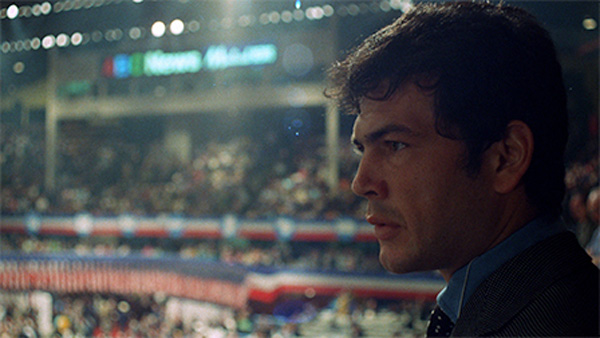
       Hollywood, eternally five years behind culture because of long production schedules, finally caught up to the social revolution in the late 1960's, birthing the New Hollywood movement with films like The Graduate and Easy Rider. Haskell Wexler, famed cinematographer, decided to get to the heart of the issue of America and start a revolution in film at the same time. The film tells the story of a devoted and moral cameraman, John, who is placed amongst real footage.
        Medium Cool revolutionary technique was fictional use of cinema verite, blended with real documentary footage that aided the plot, as well as Easy Rider-esque editing and structure. John attempts to get the footage he wants to shoot, not the footage his unscrupulous boss desires so it can be sold to the police and FBI.
        The film bluntly states its mission in one of the earliest scenes, which is a long, documentary styled sequence in which a party discusses the merits of television as a medium and the moral responsibilities of a camera man. The opening shows John and his sound cooly looking at a highway wreck, and only after getting footage so they call the police. At the film's abrupt conclusion, we are once again presented the situation. However, Wexler does not give us an answer explicitly, as we must find our own. Should a cameraman be more camera or more man?
       The first half is John operating as a camera, going to various locations and filming what he is assigned. However, his humanity undercuts everything, forcing him to focus on a human interest story of a black man who returns money found in the cab. The story is unpopular with the man's friends, who see him as interested in the man because of his race and accuse John of attempting to make a circus out of the act ("Human Interest? Are humans going to be interested by us, or we humans?") while John's television boss finds the story bland, and eventually fires John.
       The next half shows John's humanity, undercut with his profession. He falls for a woman, Eileen, with a young son, Harold, who he cares deeply for. John takes a break and falls in love with Eleen, although he stays interested in society. One incredibly scene involved shaky, free footage of a hippie nightclub, using bright colors and odd cuts in harmony.
       The film's most memorable scene is the very end, in which Harold runs off while Eileen looks for him amidst the Democratic National Convention Riots. While Eileen is there, we see real footage of police brutality. Wexler predicted a riot at the convention, yet not the fact the police instigated the incident. The riot sequence is more a historial document that a part of the film's narrative, though it feeds the environment and tone of the film. It is edited in such a way that we never forget where we are: The convention, yet still with Eileen. The plot still lives even through the reality of the footage, a feat nearly impossible to pull off.
       However, Medium Cool is mainly remembered as a time capsule rather than a work of film. Truthfully, I admire its structure greatly, as well as the risks it took. The film succeeds at its ambitious reach, standing as both a history and a work of art.

Wednesday, August 7, 2013

MONSIEUR VERDOUX (Charles Chaplin, 1947)


       Today, Charlie Chaplin is perhaps the most recognizable icon in film history, and at least silent film's most recognizable icon. Chaplin is pretty much only remembered for his tramp character, which he lived under for his entire career. Even his 1940 transition to talking pictures, The Great Dictator, a highly political comedy which satirizes Adolph Hitler, uses a tramp-look-alike, even though Chaplin insisted that this was not the tramp. Chaplin only completely left the charcter behind in the dark comedy Monsieur Verdoux.
       Chaplin is the title character, a french family man who, after being left jobless in the stock crash, began to wed and murder wealthy woman, feeling completely justified in his actions to acquire money for his family. The idea was first conceived by Orson Welles, who was very close to directing (and partially writing) the film, but Chaplin grew uncomfortable with the notion of not having total control. Welles later said that his version would have been better, not that Chaplin's was bad. Welles, I believe, was right on both counts.
       Chaplin, of course, shows his acting brilliance as Verdoux, and the film shines at several moments. Perhaps the most blatantly hilarious scene involves Verdoux trying to kill a wife while fishing, and failing miserably at every attempt. Some supporting characters, like the family of one of his victims, are just fantastic, as the entire family seems to be completely incompetent.
       However, Chaplin was not a great director, and is stuck in the silent era with his flat images and closed spaces. Sure, its not bad, but Welles could have certainly made a more visually interesting film. Chaplin also seemed to struggle with the other side of film creation, not knowing what to do with the story of the actors. The plot of Verdoux's family is woefully underdeveloped, and has zero closure. It's assumed they die, or at least leave, but we never know. They simply evaporate from the film. The beautiful swedish ex-convict has zero development, and we hardly know her. It is fine when Verdoux lets her go, but when she reappears at the film's end, it is hard to care about her now. Another issue lies with the ending. Like the Great Dictator, we have another monologue, this time in the form of a closing court statement, but it now seems detached from the film. Dictator's monologue is seperate from the film as well, but at least has some ties. The sweeping statement from Verdoux, where the character points out society's acceptance of war and soldiers but condemns those that murder "one, instead of millions" is powerful, but oddly inserted.
       It is easy to see why Verdoux was unpopular at the time and resulted in a hit to Chaplin's reputation. Not only is the hero a murderer and without remorse, he is anti-religious, anti-war, and anti-nationalist, and is depicted as a certain gentleman. Chapin was later exiled for his communist sympathies, after Limelight. Despite Verdoux's flaws, and the fact that it could have been a masterpiece with a Welles-Chaplin collaboration, it is still a solid and entertaining film.

Friday, August 2, 2013

Luis Bunuel Retrospective Pt. 3- LAST FILMS IN FRANCE


       After Simon of the Desert, a short personal film, Bunuel moved permanently went to work in France. Bunuel still lived in Mexico, but went back to France every few months to make a film. Here, Bunuel slowly became more avant-garde and unlearned much of his commercial narrative flair. This work is, in my opinion, his most daring, admirable and ambitious, and much of it has not been replicated since. All of Bunuel’s work from this period is preserved with high-quality prints, and is readily available, much of it published by the well-respected Criterion Collection.
       Belle de Jour and Tristana, both starring Catherine Deneuve, stick with rather traditional narratives, not that is in any way a bad thing. Denueve plays similar characters- repressed young woman restricted by their men. in Belle De Jour, Denueve is a sexually repressed housewife, while in Tristana, she is essentially held captive by her uncle, Fernando Rey in a role similar to Viridiana’s domineering uncle. Both films return to Bunuel’s themes of repression, and Tristana in particular features several religiously charged images, such as the massive bell over Toledo, showing the showing the power of religion over all.
       Bunuel’s late career is defined by a “trilogy” of absurd, abstract films he made in the late sixties and early seventies- The Milky Way, The Discreet Charm of the Bourgeoisie, and The Phantom of Liberty. All three have loose, sprawling narratives, and are only linked thematically. The Milky Way deals exclusively with religion, showing Bunuel’s issue with the organization, not the belief in Christ or in Christ’s teaching.
       The Milky Way follows two pilgrims on the Way of St. James, making their way to see a shrine (The Way of St. James was the original title of the bright strip of stars in the sky, and thus the film’s title). The two come across various oddities, including blind fortune tellers, odd banquets, and executions. The two seem to traverse through time and space, meeting figures dressed in all kinds of garb, from modern suits, to fancy cloaks, to simple sheets like Romans. The film ends with a powerful scene, showing Christ, who we see throughout the film as a real human, laughing and such, heal two blind men and ignore their requests to have their first sights explained to them while he states that his mission on earth is to tear humanity apart with his beliefs. The healed blind men follow Christ with their walking sticks, unable to cross a ditch without feeling across it. Although they now have the power of sight, they can’t see the world better at all, which is Bunuel’s opinion on religious enlightenment.
        Discreet Charm broadened its attack, mocking the upper society’s ambitions and fears, still laying into Christianity, with the powerful character of the vengeful priest, forgiving his parents’ killer on the guy’s deathbed moments before blowing his head off. The plot travels through dreams, stories, and dreams within dreams, focusing on a group of upper class friends who want to dine together, but simply cannot. The film is widely regarded as Bunuel’s masterpiece, winning him the Best Foreign Language Film Academy Award, and finally thrusting him into the public forefront. Sure, Viridiana, Exterminating Angel and Belle de Jour were well known, but Discreet Charm surpasses them all in name recognition.
         Bunuel then returned to some good ol’ fashioned surrealism with the ever-bizarre and free Phantom of the Liberty, a sprawling series of loosely connected vignettes, some basically operating as ideas Bunuel found interesting or humorous, jotted down, and then filmed. He explores all of his favorite themes in depth, with a young man sleeping with his Aunt, priests drinking and gambling but repelled by sex, and a young girl reported missing despite being in the same room as her parents and the police, and all adults directly addressing her. Perhaps the funniest and strangest image is when Bunuel returns to dining, having a group of upper-class friends sit around the table on toilets, talking only about deification, while the mere mention of food is repulsive. One man pulls up his pants, excuses himself, and asks the maid quietly where the dining room is. He talk himself in a small stall and opens a cabinet, revealing a chicken dinner he cuts into. The vignette satirizes the criteria of social selection- easily we can see how eating could be considered gross, and we could be trained to accept pooping as normal. In fact, pooping is more natural than easting, and much more universal.
         Bunuel’s final film, That Obscure Object of Desire, returns to a more traditional narrative but with a good amount of experimentation. The film tells the story of an older man, Fernando Rey, who falls madly in love with a young woman, played by two different actresses in alternating scenes. One actress is kind to our hero, while the other one openly taunts him and denies him of sex actively. The film is undercut with a deeply paranoid plot of terrorist takeover, showing the certain triviality of Rey’s quest.
        Four years after Obscure Object, Bunuel died at age eighty-three. Although I wouldn’t say he was forgotten, many of his films have been overlooked and are essentially unavailable in America. Tristana was just made available this year, while only three films- Obscure Object, Tristana, and Belle de Jour are available on Blu-Ray in America (although one can easily get an import of Discreet Charm and L’Age D’or on the high definition disc). Besides that, many of his later films are on DVD, while many of his Mexican films, I’d even say the bulk, are not even on a major DVD. Many exist on terrible prints, and some are not even available on a torrent website. Bunuel certainly gets respect, but certainly demands more. I urge that some company work on getting this master’s prints and finally doing them justice. I know there are financial factors at play, but I’m sure that consumers exist, and if a company like Criterion picks up the rights, the market will be created with Criterion’s tendency to build up buzz for under-appreciated titled, like what it did with the Pierre Etiax collection earlier this year. Perhaps Bunuel’s “lesser” works can be collected in an eclipse set, while many could be stand-alone releases.

         Bunuel still hold audiences to this day. His style is very straight-forward and unpretentious, nearly invisible at times but always working and shocking audiences with powerful themes and imagery. Thirty Years after his death, Bunuel is still remembered fondly and loved by many, and hopefully major interest in him will grow in the upcoming years.

MCCABE AND MRS MILLER


  Robert Altman, one of the American masters of cinema, at least in my opinion, made a major impact on the Western genre by essentially grounding it in reality with McCabe and Mrs. Miller, taking several tired cliches, reverting them, and adding in a dose of realism. McCabe, an odd gambler and unconventional hero, attempts to build up a railroad town, bringing in prostitutes, gambling and pubs, turing the quiet snowy land into the quintessential wild west town, drawing eyes from major businesses. Mrs. Miller comes in with her own prostitutes to help McCabe, and the two embark on an ultimately doomed relationship.
        The film’s cinematography is absolutely gorgeous, using long takes and slightly overexposed film to give it a washed out, old-time sepia look. The film perfectly utilizes one of my favorite musicians, the incomparable singer-poet Leonard Cohen, using several tracks from his debut album. The rest of the sound, however, is the film’s greatest weakness. It seems Altman and his crew miked  every person, then decided to mix the track later, giving it a foggy, muddy noise.
       McCabe is essentially a dirt bag, unscrupulous and greedy, but falls for the opium addicted Mrs. Miller, who like-wise falls from him. Warren Beatty and Julie Christie are both fantastic, putting aside their real-life romance to portray two lovers who are completely incompatible.
       McCabe dooms himself by attempting to play hard ball with two representatives of a massive corporation, who resent his games and leave before he can accept their offer. The company sends a hulking man with two toughs to end McCabe, but unlike most brutes seen in Westerns, the huge man is sophisticated, intelligent, and suave, easily outsmarting and weakening McCabe psychologically and ruining his reputation in town. Now, McCabe is alone, and must defeat the enemies.
       But Beatty is no Gary Cooper, and does not march out into the streets to fight against his foes. McCabe is a weasel, and thus acts like one, or at least the audience would view him as cowardly if expecting a Western. Truthfully, it is just realistic. He shoots his enemies in their back, a major faux pas in Western lore, and sneaks in hide in the fresh falling snow.
       Christie, meanwhile, feeds her addiction, and smokes opium while McCabe defeats the leader of the posse, but dies in the process. Ultimately, the film is about the relation between the title characters, and its doomed, incompatible nature, having to end on the definitive note of McCabe dying alone in the snow.

Wednesday, July 31, 2013

LONESOME (Paul Fejos, 1928)


       A major flaw with modern audiences' perception of film is the overemphasis on story and audiences' fixation of it even when it is unimportant and only aids a theme. Some films can have great visuals, yet not hold up at all because of the lack of story and the fact that it attempts to make the story important and a true fixture of the film, like a "traditional" film. A film like this would be Tarsem's The Fall, a shallow, stupid film with admittedly lovely issues.
       Two late silent era films are often criticized today for their lack of an interesting story, relying on old cliches of love. The first is Sunrise, which is certainly the more well-known of the two, but the second is Paul Fejos's often forgotten Lonesome. Lonesome was lost for many years, and could be criticized for its run-of-the-mill plot- two lonely individuals meet and fall in love, only by knowing each others first name, and soon are separated. The plot doesn't do much, but Lonesome is still a spectacle to behold today, with its unconventional structure, awesome tinting and hand-painting, and its odd use of sound and dialogue.
         Paul Fejos, a European who was a doctor and anthropologist as well as a filmmaker, builds the atmosphere of Lonesome by first dissecting New York city at a whole. Much of the film serves as a New York city symphony, which was an early documentary mode, most famously seen in Veratov's Man with the Movie Camera. The first inter-title describes New York as a machine, and we soon see its inner workings through an array of shots, and a good amount of superimpositions. This graphic structure itself is interesting, and makes up most of the film. A good portion of the film takes place at (presumably) Coney Island on the Fourth of July weekend, serving as an event documentary, displaying the sprawl of the city and its often dehumanizing effect. This theme aids the simple plot, and takes the weight of the theme off of the literal story.
       Tinting and hand-painting of old film is a technique that still impresses to this day, as one can really appreciate the amount of hard work one puts into the process. On top of that, it just looks beautiful. Fejos changes the color of the tint on a mid-shot of the two lovers multiple times, while a great sequence shows the gentle coloring and lighting of a two lovers, alone on a bench (despite the fact that the dock is always packed besides this scene, and in fact, the lovers almost lose each other in the herd, but is empty for this one shot, which works emotionally instead of literally-rare for such an old film) adorned in yellow amongst a dark blue surrounding, again showcasing a "us and them" mentality, separating lovers from the swamp around them.
       It is worth noting that Lonesome was an incredibly early sound film, I believe Universial's first, and only three or four scenes have spoken words. However, the dialogue is just bizarre, stilted, and hokey, reminding me of the great early sound parody "Tomatoes Another Day." The last sound sequence shows a confusing dialogue between the man and a cop, where the police commander speaks with sarcasm, but it is completely covert- and intended to be so, since our hero is upset. The dialogue is usually incredibly weak, but the one instance of deliberate toying with tone is an interesting direction experiment.
       Lonseome is far from perfect, and it certainly makes sense why it was forgotten for so long. It is a strange, strange film which doesn't ever really know what it wants to be. However, its indecision makes it incredibly interesting and certainly worth a watch. All in all, Lonesome's oddity warrants a watch for its history and sustained entertainment value.

Monday, July 29, 2013

Luis Bunuel retrospective- Part 1- EARLY LIFE AND EXPERIMENTS


       July 29th, 1983 (30 years ago, today) marked the death of Luis Bunuel. To some who consider themselves fans of film, this may not mean anything, while it may mean everything to some. Luis Bunuel, despite his sterling reputation (for example, They Shoot Pictures lists him as one of the three "master" directors, meaning a perfect 10, along with Howard Hawks and Alfred Hitchcock), is criminally unwatched and undervalued among the general public. Many of his films are rare and hard to find, but I'll get into that later.
       Now, I have written on Bunuel much before, but now, I just don't want to republish something, which I've done on a few occasions. My writings on Bunuel earlier were academic and lengthy. Perhaps I will publish it at a later date, but for now, I will write new material. I may borrow from my previous writings, however.
       Now, perhaps a little bit of background on Bunuel is needed to truly understand him. Bunuel was born in 1901 in Spain, and grew up in a religious aristocratic family, two relations which run deeply through pretty much every film he has ever done. Additionally, Bunuel admits in his (excellent) biography that he was very sexually oppressed, another constant theme. When he was eighteen, he went of to University in Madrid, where he met several creative minds that like Federico Garcia Lorca and Salvador Dali, with whom he would be closely affiliated.
       Bunuel's artistic awakening came in Paris in the late 1920s. At this time, he allied with many of the surrelists, such as Max Ernst. One of the most fascinating parts of Bunuel's biography The Last Sigh is that the book works as a first-hand report of the surrealist movement, and Bunuel really dives into what the movement was in his eyes- less artistic, and more of a new system of reality which rejected everything society cherished. In Paris, Bunuel worked as an assistant for the early French silent director Jean Epstien.
       In 1929, Bunuel and Dali set out to make a film with funds Bunuel secured from his mother, despite her never actually seeing the film, and never expressing any interest in doing so. The result was Un Chien Andalou, which still is Bunuel's most popular film, although it does not show off the director's skills sufficiently. Bunuel's genius was in story-telling, and Un Chien  is pure non-narrative, and Bunuel stated several times that it is supposedly total nonsense. I must admit that when I was an early teenager I first heard of Bunuel through Un Chien, where he was essentially just "the guy that's not Dali."
       Un Chien Andalou had an instant and massive influence, specifically for its odd structure and bizarre images, which in fact does capture much of Bunuel's essence. Perhaps one of cinema's most iconic images is the woman being held by a man (who is actually Bunuel) as we see a cloud slice through the moon. Then we see an eye sliced (where, yes, the name of this blog comes from) with plasma oozing from the slit. It's instantly memorable, as is another fantastic image, of a man weighed down by a dead donkey, a grand piano, and two perplexed priests (one of whom was Dali), which represents a recurring Bunuel theme- the strains of upper society and religion on all aspects of one's life. Dali's influence can be felt in many of the images, such as ants crawling through a man's hand. Bunuel's dreams were much more rooted in a worldly reality than Dali's, which kept him grounded and decidely unpretentious.
       Next, Dali and Bunuel collaborated one more time before breaking their partnership permanently. This film was L'Age D'Or and is certainly much more Bunuel's than Dali's. The collaboration was fading quickly due to the emergence of Galla Dali, Dali's falling out with the surrealists, and that the duo simply wasn't as inspired together as they once were. The film was just over an hour long, and bore the distinction of being one of the earliest sound films made in France. The film is certainly a spiritual sequel to Un Chien and resembles it like no other part of Bunuel's filmography. Here, Bunuel revisits many of the same themes, but takes an extra blade out towards the church with the final scene, which is a reenactment of a scene from De Sade's 120 Days of Sodom with Jesus as the perverse duke. The Christ figure comforts a young girl, leads her back into the cave, and after a scream, he emerges, now without a beard. The final image is a cross adorned in scalps of women, which implies violence against woman is the trademark of church history.
        Compared to Bunuel's later filmography, his first two films are unique and worth visiting, but certainly do not reflect Bunuel's filmography at all. Bunuel was so much more than chocking imagery, and I have a tough time getting some people to watch any of his films if they are familiar and dislike his trademark eye slice. L'Age D'or shocked France so much that it caused riots and was banned by the government until 1980. Bunuel fled France, not returning until the 1960s. He went to Spain, where he filmed the thirty minute Las Hurdes, financed for a minimal amount of money.
        Las Hurdes receives a good amount of recognition for its status as an early documentary, and one of the earliest with such a political statement like showing the crippling poverty of regions in Spain. We see several shocking images again, but now, they are rooted within reality. We see close ups of a young girls mouth, as we hear that in a few days, the toddler will be dead. A donkey is stung to death by a hoard of bees while orchestral music and a dry narration goes forth. Bunuel again seizes an opportunity to attack a favorite target by focusing on a massive structure among this wasteland- a catholic cathedral, of course.
        Las Hurdes again caused huge controversy, halting Bunuel from making any films from years to come. Bunuel fled Spain for the United States on the heels of the Spanish Civil War, where he would have certainly been viewed as a political threat subject to assassination. Bunuel landed in Los Angeles at first, living with Charlie Chaplin for some time (Chaplin allegedly used to scare his daughter, Geraldine, by telling her images from Un Chien Andalou  before bedtime) and then worked at the studio. Eventually, his wife came over with his two sons, and the director moved to New York, where he was on the MoMa board before Communist ties forced him to resign. Bunuel was broke in New York with no job and no prospects, until an old friend living in Mexico contacted him with a directing opportunity. The year was 1947, and Bunuel had not been behind a camera in fifteen years, and had never even made a feature length narrative, but he accepted the job to make La Gran Calavera.

Friday, June 21, 2013

A FACE IN THE CROWD (Elia Kazan, 1957)


       Although I usually don't like to use the word "Underrated" regarding film, as it's incredibly overused as it is, Elia Kazan's 1957 film A Face in the Crowd certainly fits the criteria (or actually, "under viewed" might be a better fit. Although it receives acclaim now, Kazan's originally critically reviled film isn't seen as the classic it truly is.
       The late Andy Griffith hypnotizes the audience as Lonesome Rhodes, a crazed, larger than life radio personality who takes the world by storm, only to use his huge, loyal audience for his own benefit and exploits them. Rhodes doesn't even exploit them for his own ideological gains- he seems too stupid and monetarily interested to have his own opinions.

      Rather than a typical look at the film, I've decided to republish an older essay on Kazan's film, exploring the film's treatment of celebrity excess:


       Elia Kazan’s 1957 film A Face in the Crowd stars Andy Griffith stars as Lonesome Rhodes, a drifter who a radio station hires to sing songs and spout “Grass root wisdom.” From his humble beginnings, Rhodes becomes a phenomenon with a rabid fan base and a national television program. Kazan uses his characters to show the realities of the media culture. Lonesome Rhodes represents the powerful, narcissistic, nearly unstoppable media, while his love interests represent the general public’s reaction to the media. A Face in the Crowd serves as a portrait of the media, the characters it creates and the general public’s reaction.
       After being released from jail, Rhodes slowly begins to realize his impressive amount of power: first as an entertainer, then as a voice of the people and finally as a political figure. Rhodes’s power was always imminent on screen through his presence in the frame. When the audience is introduced to Rhodes, he is hungover, sleeping in the corner of the county jail. He is completely absent for the several minutes of the film, but after the sheriff wakes him, he immediately becomes the film’s focus. 
       Throughout the majority of the film, Rhodes occupies the middle of the frame, representing his massive personality and his unstoppable nature. If Rhodes is not in the center of the frame in the shot’s beginning, it seems he moves within the frame to become the literal center of attention. However, at the film’s end, Rhodes embarrasses himself on the air, mocking the audience, and forever loses his seemingly unstoppable power, as well as Marcia Jefferies, the woman he loves. The film’s final shot is of the New York City landscape: Taxis, skyscrapers, and a large neon Coca-Cola sign. The audience can hear Rhodes cry into the night, but he is nowhere to be seen: His celebrity has faded.

       Rhodes’s relationship with the public is represented by two women he loves: Betty Lou Fleckum and Marcia Jefferies. Fleckum represents the mass public. Fleckum, who becomes Rhodes’s wife at age seventeen, is at first completely infatuated by him, even admitting to have a picture of Rhodes taped to her ceiling. However, Fleckum quickly looses interest and cheats on her husband after several months. Rhodes’s true love is Jefferies, who represents the more educated public. Jefferies, a radio producer, discovers Rhodes in jail, and planned to wed him, but Rhodes became hypnotized by the energetic passion of Fleckum. 
       Despite his betrayal, and her first hand knowledge of the artificiality and deep-rooted corruption of Lonesome Rhodes, Jefferies still loves him, and was unable to leave him until the film’s end. Jefferies directly causes Rhodes’s downfall, as she is responsible for leaking his off-air comments, where he calls the audience idiots. Jefferies felt that her and Rhodes could only be separate if she ruined his career. Like the public, Jefferies overlooked Rhodes’s unappealing behavior and focused on his status and power. Once his fame was diminished, Jefferies could leave. Ultimately, the power of media and celebrities transfixes the public and holds them captive until the glossy lights of fame are dimmed or removed.

Wednesday, June 19, 2013

LIFE IS SWEET (Mike Leigh, 1990)

       Mike Leigh is an anomaly. It's rare for a director to be so acclaimed, yet receive so little mainstream recognition in America. Sure, Leigh gets a ton of recognition from the niche cinephile crowd, like the Criterion Collection, but Leigh's films have never had a major studio backing. Perhaps his films are just "too British" for America in many ways, full of dry wit, quirky characters, and dark moments of drama contrasting from the established tone.
       Perhaps Life is Sweet is the finest example of Leigh's style, and his "British" touch, even though the film's has an decidedly American focus of a family trying to succeed and, in a word, follow their dreams. The father, Andy, is a successful head chef who buys a broken down food truck. His wife, Wendy, seems to be a housewife first and tries to pick up a career afterward. Their two twenty-two year old daughters appear to be polar opposites- Natalie is a neat, short-haired, focused plumber's apprenticed, while the frail Nicola appears to do nothing but sit around all day. Essentially, the parents want to move forward with their lives, while their daughters are content, one way or another.
       The film is set in motion by Andy's brash decision to spend decidedly too much on a broken down food truck, drawing mockery and criticism from the rest of his family. Andy never really does much with the van, besides sleeping in it after a rough night at the pub. Based on his family life, Andy seems like a bumbling man-child, akin to a schlubby sitcom Dad. However, our perception of Andy is shattered when we see brief scenes of him working as a head chef- he has complete control of his kitchen. While his family life is not a total mess of dysfunction, it is certainly less sleek and streamlined than his kitchen. Andy's purchase of the truck is simply an attempt to come into his own, and truly have control of his own life, by owning a business. However, despite the impulsive purchase, Andy is slow to get started, planning and thinking practically.
       Andy's slow, planned start greatly contrasts the food-business entry of family friend Aubrey, a young, showy, unintentionally goofy young man who seems to hide his great insecurity with inflated pride. Aubrey's chief characteristic appears to be frustration- both occupational and sexual. He lusts over both Wendy and Nicola, and loudly hammers on the drums when things do not go his way, to the mocking amusement of Andy and Wendy. While Andy begins to informally plan a menu, discussing a few food items the cart will serve, Aubrey had no planning it seems besides working off his presumed culinary genius. His food is incredibly unappetizing, as is the restaurant's decor. Aubrey's rush into the restaurant business is disastrous, as he forgets to advertise at all for the restaurants opening. Aubrey represents the dangers of unchecked dreaming without realism.
       Wendy volunteers to be Aubrey's opening night waitress, adding to a string of odd jobs- child's dance instructor, baby clothes salesperson, and French cuisine waitress. However, Wendy is only seen at each of these jobs once, and she is mainly seen around her family, which is perhaps her true occupation in her eyes, even though she may resist it. As she reveals to Nicola towards the end, she  originally had other plans for her life before becoming pregnant at a young age with twins. Her decision not to abort Nicola and Natalie alters her coure in life, although she, nor Andy, seem to regret their decision. Still, Wendy takes up small, quirky jobs as means to entertain and fulfill her still young spirit.
       Of the twins, Nicola appears to be a complete mess, and the source of the biggest dramatic tension in the film. Nicola is bulimic, a fact Lehigh deals with seriously, but does not force down the audience's throats. Life is Sweet is certainly not an "issue film," like an after-school special, in this regard, biut simply is a film that, among other things, covers this topic seriously and without judgment. Nicola's bulimia is just another complication in her life and her personality- she's rude, unpleasant, and appears to be completely apathetic towards everything. Although she says she is political, she attends no rallies, does not write, and is completely non committal. In fact, when she criticizes her father for striving to be a capitalist, Wendy encourages her to join a socialist group, just so she can do something. Nicola also appears to care deeply for her unnamed lover, but tries to show no affection whatsoever. Even if she does not care for him, per say, she cares what he says and what he does. She constantly forces him to rub her down with Hazelnut spread, and then eat it off of her, relating back directly to her eating disorder, and despite blowing him off and acting disinterested, she seems heartbroken when he calls her stupid. Nicola's apathy has ruined her in a way, leaving her empty and aimless.
       Natalie, on the other hand, appears a different kind of empty. She has a solid job with a plumber, and is constantly referred to as the "happy one." However, externally, Natalie shows no emotion, especially no signs that she is happy at all. In reality, she is not the "happy one," but simply the one who is much more emotionally stable. Besides her work, though, Natalie seems to have very little. She never mentions a boyfriend or lover, despite her plans to have a child soon. Natalie's emptiness is much more subtle than the rest of the family's, but possibly could be the most devastating  she appears to have little besides a solid career, while everyone else has something- even Nicola learns how important her family is.
       Life is Sweet paints a portrait of dysfunction, but does so lovingly and sincerely. Even calling it dysfunction doesn't seem right, but I currently lack a better term. Sure the family has issues, but most do. At the end of the film, they appear completely united by a small, lightly traumatic event- a simple broken leg. After fights, every member of the family renews their peace with one another. However, their occupational peace is interrupted- the food cart is on hold, Wendy will no longer work for Aubrey after he drunkenly came on to her, and Nicola still has no idea what she will do. But the family is together, and for them, and for the audience, that is really all that matters when the film closes. We focus not on the food truck, but on the family.

Thursday, June 13, 2013

NIGHT OF THE HUNTER (1955, Charles Laughton)

Just as a note, "classic" reviews will lean more towards analysis, and be more liberal with spoilers.


       Towards the end of his stories career, world renowned actor Charles Laughton turned to directing, leading stage productions of Caine Mutiny Court Marshall and Don Juan in Hell, receiving critical acclaim. It was then only natural that Laughton should move into film direction, and did so with 1955's Night of the Hunter. The film suffered from poor contemporary reviews, and Laughton never directed another film.
       It is fairly easy to see why Night of the Hunter was critically panned at the time. In a word, the film is just bizarre, featuring heavily stylized performances, unusual pacing, and direct addresses of the camera. But for these reasons, Laughton's film acts as an important milestone in American cinema, and widely influenced future filmmakers, notably David Lynch.
       At the core, the film is a story of good and evil, but Laughton's script, which he co-wrote with David Agee, presents the story like a fable, where Robert Mitchum's corrupt preacher is not just evil, but represents evil at a whole, while Lillian Gish's Mrs. Cooper stands for an ultimate good. Mitchum is spectacular as the singing, tattooed, ever-present con-man claiming to be a man of God (and seems to genuinely believe he is a man of God), who feels his mission is to murder "loose" widows and make off with their money. He arrives at the Harper household shortly after the father's execution for robbery, and Powell sets himself to find the money he believes the dead man hid with his children.
       The stark photography aids the black-and-white morality the fable-like film creates, with high contrast throughout and heavy use of shadows and motivated lighting. Powell lives in the shadows it seems, and when the children flee, he searches for them and their money day and night. But ultimately, evil has no chance in the world of the film. Powell seems to be completely incompetent, and is unable to do harm with any opposition from good characters. He trips over glass jars, gets his fingers slammed in the door, is unable to swim, and ultimately, Gish's Mrs. Cooper accidentally shoots him when both are startled by a cat. When he's shot, Powell shrieks like Daffy Duck, showing that in the end, he's just an animal, capable of harm but easy to defeat if one is aware of him. Cooper calls the police, saying that an animal is trapped in her barn. When they leisurely arrive several hours later, Powell is still in the barn, at this point too cowardly to even attempt an escape.
       Despite his quick disposal, the audience truly believes Powell is a serious threat. When he arrives at Mrs. Cooper's house near the end of the film, singing his favorite hymn, it's once again blood-curdling. At that moment, he seems so intimidating and icy, one forgets how useless he was chasing the children just minutes earlier. However, one does not forget his psychological manipulation of the widow, Willa (Shelly Winters), and the Spoons, a naive, yet kind couple that befriended the Harpers.
       Willa at first seems uninterested in Powell, as she mourns her husband's death, but soon she believes that Powell is the key to her salvation and freedom from sin. She quickly marries Powell, and on the first night attempts to sleep with him, though Powell chastises her, and eventually indoctrinates her into his fanatical mindset. In a brillant sequence, Willa and Powell preach at a church lit by torches. One torch always engulfs the left hand corner of the screen, seemingly unmoving from shot to shot. Willa eventually learns that Powell is after her husband's money, but does not seem overly concerned. Nevertheless, Powell acts quickly, and slits her throat as she lies in bed, disinterested in her surroundings.
       The Spoons support Powell tirelessly, giving him the unconditional benefit of the doubt. After he murders Willa, Powell cries to the Spoons, who mock Willas's "loose morals," and remain completely unsuspicious, even when Powell insists that there is no way WIlla could possibly return, and when Powell disappears. Yet at the film's end, when Powell is convicted and set to be executed, the Spoons lead an angry mob, with literal pitchforks, to the prison to lynch Powell. At this moment, the Spoons are both outraged and embarrassed that Powell operated directly under their noses. Yet they do not mention their guilt of inaction, only demonize the preacher and lead a crowd in pitying the Harper children,
       The film also has several interesting points to make on religion. Religion is seen at both its best and its worst though Powell and Cooper. Powell is simply a fanatic who has lost all sight of the religion's true meaning. He does not commit to any religion, and seems to create one which aids his own needs, to the point where he believes that his personal lord sends him to widows. John Harper, the dead man's son who constantly clashes with Powell, is repulsed by Powell's fanaticism, and is the only character who can see through his nonsense immediately. Mrs. Cooper, on the other hand, is certainly Christian and routinely reads the children stories from the bible. When she first attempts to read to the children about Moses, John leaves the room in disgust, but slowly turns his head towards Mrs. Cooper in order to hear the story.
       The beliefs of Powell and Cooper come head to head during the films climax, where the two sing their own versions of "Leaning on the Everlasting Arms." Cooper's specifically mentions Jesus, something Powell has failed to do the entire film. Sure, he mentions "the Lord" regularly, but the reference is so unspecific and vague, it could mean anything. Powell's true religion is simply a self-serving one.
       Some of the film's abstract themes and techniques have heavily influenced other filmmakers. The Coen Brothers, notably their early films (but one could easily make a case tying Night of the Hunter to their masterpiece No Country for Old Men),  utilized heavily stylized performances to depict larger themes, like the demonic biker in Raising Arizona. The film allegorically uses nature to reflect the themes of the film, which has evolved to be a staple in the filmography of Terrence Malick  David Lynch used many of the film techniques, notably borrowing the film's opening, where Cooper adresses the audience in the cosmos, for the ultimate scene in The Elephant Man. 
       Night of the Hunter, while being widely influential, is completely capable of standing on its own merits as a poetic film acting very much as a modernized fairy tale, where children triumph, good exposes evil as weak and even silly, and evil is punished. Through the years, the film has gained significant praise, reversing the early poor reviews. However, it is certainly easy to understand why 1955 audiences would have been taken aback, even repulsed, by the film's odd delivery and style.