Showing posts with label new movie. Show all posts
Monday, June 30, 2014
OBVIOUS CHILD (Gillian Robespierre, 2014)
I'm really, really fighting the urge to make a joke on Obvious Child's title to lead off the article. By that, I mean that most of the film, of course, is pretty damn obvious. It's exactly what you would expect from an Indie Romantic Comedy, besides, you know, that abortion thing.
Obvious Child, the feature film debut of Gillian Robespierre, is largely hit and miss. A lot of the humor misses, but the film's heart and handling of a ridiculously touchy topic is where it succeeds. Jenny Slate delivers a fine performance, although she is weighed down by fairly typical "quirky" jokes about farting and inappropriate comments. In 2014, it's pretty familiar, but not quite yet tired. Slate carries the film completely as Donna, and shines during the emotional climaxes: Donna's conversation with her mother, and the final stand-up routine, which honestly, isn't... really funny. At all. Sure, in a filmic sense the scene works as she confronts Max, the business man who impregnated her, her insecurities, and her apparent stage fright, but the audiences guffawing actually becomes distracting.
The film handles Donna's complicated relationship with Max in a somewhat unique fashion, although it still neatly hits the conventional ups and downs of a romantic comedy. Max isn't really given a lot of dialogue, but Robespierre perfectly characterizes him by his fashion, sense of humor, and actions, most importantly his handling of Donna's abortion. The abortion is dealt with in a decidedly modern manner, completely refusing to moralize the decision, a route many films would take, and even sparing us the convention of Donna changing her mind. It's the modern world. Donna can't have a child. She knows it. Sure, there's some weight attached to the decision, but there are no last minute revelations. Donna's relationships through the film are all shaped by her decision, but in Obvious Child, all are supportive and encouraging.
Despite Max being a 'good character,' the film certainly suffers through the conventions of the romantic comedy. It seems strange how liberated Donna is in the film, yet the film its self is tied down to flat out boring romantic storytelling. The conventions are all there: Donna struggles in her job. She loses her boyfriend, and we are subjected to a scene where she waits outside of his door, counting sips in her coffee. The supporting cast is fairly generic. However, Gabby Hoffman is quite good in the "best girl friend" role. The scene where Donna waits on the pregnancy test while Hoffman's Nellie pees on the toilet is hilarious- until its shattered by another maddening indie rom-com convention, where Donna imagines herself as the DJ, and visualizes stylized flashbacks.
However, the absolute worst part of the film is the borderline offensive inclusion of the "gay best friend." The gay fellow comedian is a by-the-book gay stereotype that's ridiculously outdated. It's absolutely strange that such a character, who can barely say a line without mentioning how gay he is, exists in a film that is otherwise so modern. The gay best friend is only in a few scenes, but is always there to point out how hot Max is, or how shocked people would be if he was pregnant! Because he's gay! Get it!?
Robespierre's debut is certainly interesting, flawlessly taking on a incredibly difficult subject, and manages to find the humor of it, as well as the emotional core, all while refusing to moralize the situation in any way. the films flaws lie not in its tackling of the abortion, but in the secondary plots, relying on boring, even offensively boring, characters, and ultimately ending the love story on a weak open-ended note. However, despite the criticisms, Obvious Child earns its title as the Indie Comedy of the season. Robespierre makes an exciting debut, leaving me very excited for her future as a filmmaker, and boats a potentially star-making performance of Jenny Slate, although she should be lauded more for the dramatic performance than the comedic.
Friday, September 27, 2013
BLOOD BROTHER (Steve Hoover, 2013)
Documentaries are starting to have a real problem: They're all the same. Most directors prefer to stay a certain distance from their subject, even if they have every reason to move closer. I wouldn't be surprised if there was a secret committee who only approved of one type of documentary, forcing 99% of them to have the same construction.
Blood Brother is a movie that's probably going to get a 98% on Rotten Tomatoes. Like most social documentaries, who wouldn't like it? It's a great story. Rocky Bratt, a somewhat troubled young American, goes to India and finds himself loving his life at an HIV orphanage. Bratt really engages with the kids, gets his heart broken nearly as often as he succeeds, and loves the country in general.
So what's not to like? The film seems empty, in a word. The entire opening is Rocky doing nothing in particular in America. The footage is great, but assembled in such a way that I don't know what the aim was? Rocky? The kids? Rocky's relationships? HIV? It's just bogged down, and deemphasizes the kids in such a way that it falls dangerously close to the "White Savior" treatment.
The film's structure is just odd, having the imprint of a traditional narrative, but ultimately cannot put it all together. It's like a few strips of tape were slapped over the entire thing. Rocky is the only true character in the film. The kids are like props, occasionally being brought out and held up to the camera. The frustrating thing is that we certainly see enough footage that could really illustrate certain children and bring them to the spotlight. The one boy, who gets dangerously sick towards the end, is said to "always be around" yet we see him twice- in his sloppy introduction, and when he's near death.
The music, combined with the editing, adds another depth of irritation to the film. The mythical Documentary Committee I mentioned earlier apparently only approves of films that have a few "happy" montages of people dancing and running, and scored by a strummy string quartet piece. If we're having a flashback, better have some animated sketches.
Documentary has really become flavorless recently. Sure, there's exceptions that really try to do something interesting and "represent the truth"in an honest and engaging way- I'm thinking along the lines of Restrepo, Exit Through the Gift Shop, Smartest Guys in the Room, Inside Job and Waltz with Bashir. But the vast majority seem to fall under the vanilla production line aesthetic of Jiro Dreams of Sushi, Hell and Back Again, and now Blood Brother.
The real tragedy of Blood Brother is not just that's its bland, typical, and out of focus, it's that it could easily be good. There are editors and directors that could take the innumerable hours of raw footage shot and make something truly engaging, intelligent and downright interesting. If Blood Brother told a bad story, it wouldn't be as infuriating as its end result: A good story told in a bad way.
Wednesday, August 28, 2013
BLUE JASMINE (Woody Allen, 2013)
Woody Allen has recently been quite hit-or-miss, but he truly makes whatever he wants, be it dramas (Match Point), vignettes (To Rome with Love) or experimental narratives (Melinda and Melinda). However, really nothing he has made has been terrible. Allen's last massive success was Midnight and Paris, a wackily set human comedy that drew great attention for its historical aspects, even though it had some weaknesses.
However, with Blue Jasmine, Allen scores his best film in some time, and truthfully, one of his best period. Cate Blanchet's performance is simply unreal, and without a doubt the highlight of the film. It actually becomes uncomfortable to watch the nervous breakdowns of Jasmine about her state of life, relationship issues, and unsure future.
Forced to move in with her sister after her husband is imprisoned for financial fraud a la Bernie Madoff, Jasmine moves to San Francisco, claiming she's out of money despite her first class plane ticket and refusal to sell her designer clothes. Alec Baldwin, in flashback, plays Jasmine's husband, and Baldwin may be the weakest link in the film. Not because of his performance, but simply because of his underutilization. Baldwin doesn't do anything in particular, but really, this is an issue that only arises in retrospect.
Great performances dot every minute of the film. Sally Hawkins is brilliant as Jasmine's meek "lower-class" sister. Bobby Cannavale is great as her current boyfriend, while her fling is portrayed by Louis C.K., who is good enough to not be completely distracting. However, the best performance in the film is by Andrew Dice Clay, the critical scorned abrasive comedian, as Jasmine's ex-brother-in-law, resentful towards his entirely family and emotionally reeling both times we see him- first trying to fit in with Jasmine's high society, and then hurt financially by Baldwin's money games. Michael Sturburg is both pathetic and unsettling as Jasmine's temporary employer.
Allen structures the film in a certainly peculiar manner, abruptly changing from past to present. In fact, I was lost for a few seconds in a time change, although I quickly recovered and dove back into the film. Allen creates an interesting tone as well, mixing emotionally raw drama with dry humor, kind of like his typical style mixed with Cassavetes. It's a unique blend, and one I can't think of having seen before. Unflinchingly, I would declare Blue Jasmine as Allen's best film since (at least) Hannah and Her Sisters, which is no small feat, considering the strengths of Match Point, Mighty Aphrodite, and Midnight in Paris. Allen creates a very real portrait of modern emotional turmoil with Blue Jasmine caused from betrayal, snootiness, and culture shock.
Monday, August 26, 2013
Spike Lee- Power through Freedom
Currently a hugely controversial figure for his commentary and actions, Spike Lee is, for some reason, hated on the internet, although really, they should love him. Currently, it's hard for me to think of a filmmaker whose voice through his films is so loud and consistent throughout his body of work. However, that's not saying every film is the same, in fact, the truth couldn't be further from that.
Lee's real-life, and thus cinematic, home is Brooklyn, and thus most of his films are not only set there, but reek of the attitude and life of Brooklyn. Lee got his start from independent filmmaking, and despite a relationship with Universal Pictures, has remained very much an independent filmmaker, denying the industry of content that would typically be consumed by the masses. Because of this, the "controversy" the internet brewed over his kickstarter is particularly absurd. The internet seemed to have zero problem with the Veronica Mars movie, even though that was being made by more people and asked for much more money. Lee has stated that he crowd-funded before Kickstarter existed, and that is very much true. 2012's Red Hook Summer was self-funded, and the film is truly very good.
However, RHS, like much of Lee's work, features a trademark of his style some would see as a weakness- his pacing is a bit odd, and some aspects of the story are rushed or simply forgetten. FOr example, the revelation about the reverend in Red Hook Summer comes out of seemingly nowhere, while a building of a ten-year marriage of Bleek and Indigo in Mo' Better Blues is rushed at the end, allowing the story to end in a cycle, a neat technique but one that isn't needed.
Lee is one of the rare modern filmmakers who constantly feels the need to innovate and experiment with his work, adding in odd camera angles and story structures. Perhaps one of the best example of this appears in Mo' Better, where Bleek calls the two women in his life by the others' name. the scene is shot as if they were in the same room, with Bleek turning different directions to address the different woman.
Lee's career can be best defined by two films- Do the Right Thing, which I previously discussed at length, and Four Little Girls, a powerful documentary about the bombing of the Birmingham Baptist Church at the peak of the Civil Rights Movement. Lee understands this to a degree. After DtRT, Lee made MBM, certainly a good film, but far from the sprawling, powerful, and poignant the preceded it. Lee's career may have been in jeopardy if he followed Do the Right Thing with Jungle Fever, a similarly themed film that pales in comparison due to some hokey and goofy moments, despite some really great scenes and powerful performances.
Lee does not get the reputation he deserves, often just criticized for controversial statements. Lee currently takes heavy heat because of his remaking of Oldboy, an inexplicably popular Korean film with a cheap, stupid ending. Even if one likes the original film, one should realize that it's not an unbridled masterpiece, and how interesting it would be to see Lee tell the story in his own way, with his own characteristic flair
Labels:
Classic Film,
directors,
Lee,
new movie,
spotlight
Monday, August 5, 2013
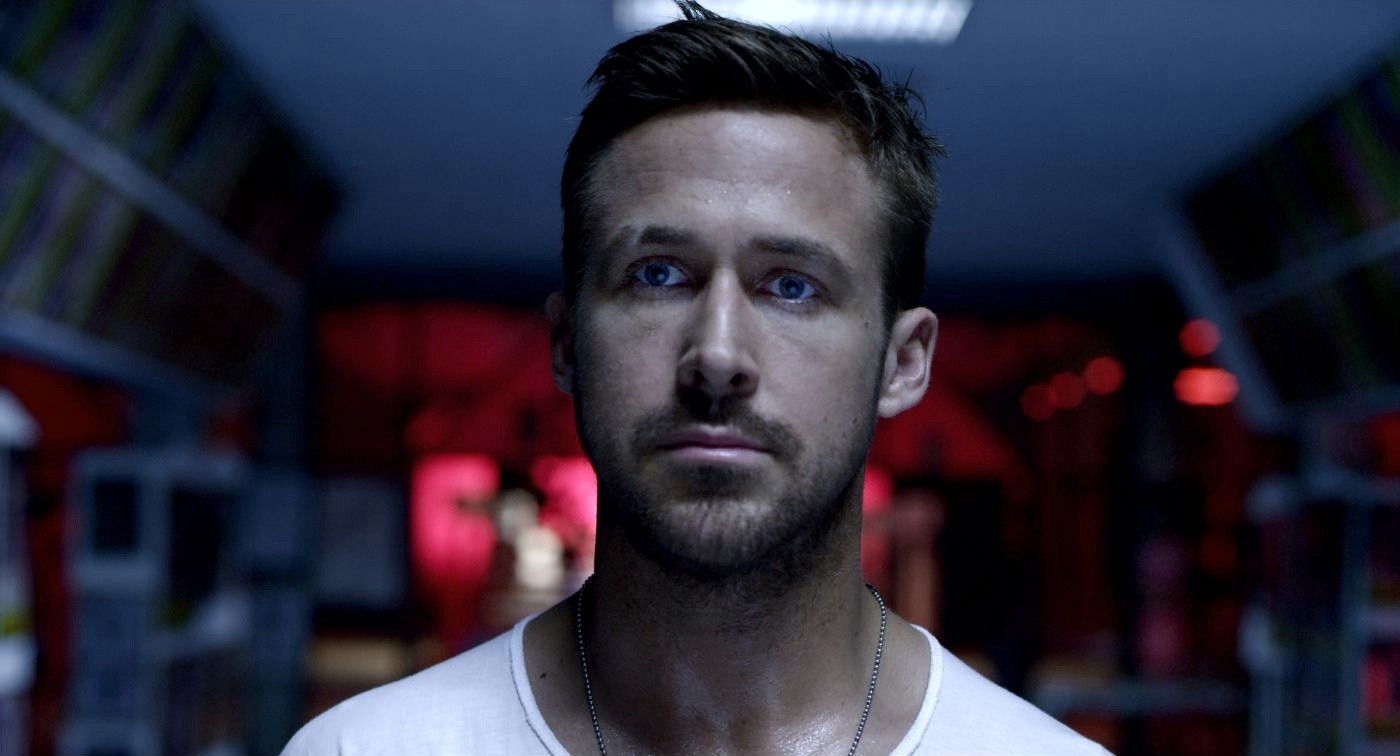
ONLY GOD FORGIVES (Nicholas Winding Refn, 2013)
Maximization is the easiest way to hide terrible craftmanship. If you have nothing except sex, you have porn. Nicholas Winding Refn tries to prove that with nothing but violence you have art. Well, in a way, of course you do. Porn is art as well.
Now, Refn wants us to believe there is a deep meaning behind the pretentious mess that is Only God Forgives. Sure, there's some "symbolism" alluding to a man's anger towards an ultimately powerful God, and futile attempts to betray God, and an ultimate penance. However, everything is so blunt and obvious, it requires zero work from the audience member. Now, people claim OGF gets bashed because people didn't expect an art film. True critics can adapt their expectations, as I did, but OGF is just shallow and full of itself. But really, that shouldn't shock me.
Like Refn's other work, OGF is flooded with bright colors and pulsing electronic music. The characters talk stiffly, and here, its essentially a self-parody of the language in Drive and the awful Valhalla Rising. While not awful, I must say that Drive is not the masterpiece many claim it is. The atmosphere is cool as hell, but the film is pretentious and dopey, obviously striving to be remembered as the "unconvential classic" that college pot heads have posters of in their dorm rooms. OGF lacks the cool atmosphere. The color pallet actually becomes boring as hell. However, the soundtrack is interesting, but unfortunately its piled upon layers and layers of uninteresting. Its like a layered dip made of rancid meat, curdled sour cream, acidic and slimy beans, soggy chips, wilted lettuce, and some pretty good Cheddar. Who the hell cares if the cheese is good? No ones going to notice.
The film is just so obvious yet striving to stay edgy and mysterious, its just goofy. The violence, most of the time, means nothing. The Kareokee scenes are just goddamn stupid, as are scenes of Chang, one of the blandest villains I've ever seen, possibly even trumping the gangsters in Mud. Yeah, he's a warlord, but look how he treats his daughter!!! I mean, how many times have we seen that? I don't even think it's possible to count.
I don't even know how else to convey that this film is awful, yet I understood every goddamned second of it. It's so shallow, yet think's its the deep end, and you an practically imagine a stoned Refn sitting at an end of a bed, explaining to you while using his hands animatedly "Yeah, but, Chang, man, he's like a God, and Ryan Gossling, I mean Julian, man, he's like, I don't know, uh, working for Satan. His family, they're sinners, man, and he fights and fights, until he realizes 'Oh shit, man.' But then God, I mean, Chang, man, his brand of forgivness is sacrifice. His hands, man. I'm gonna show his hands, cuz that's all he has, man. Oh, and red. I'm gonna show a lot of red. And Blue. Because of, like, satan and god, man." I am actually offended that Refn wants people to buy into this obvious, insulting, exceedingly violent for violence's sake piece of neon coated shit, and just depressed that people do.
Refn has proven to me, without a doubt in the world, that he is a hack. Refn's filmography is a bastardized orphan of Kubrick, Lynch, Michael Mann, and Quentin Tarantino, yet has no idea what to do with his influences, so throws everything into a blender and pours out goddamn messes every time. At least Drive is watchable, even re-watchable, despite it's flaws and annoying tendencies and tones, but OGF is just unbearable.
Monday, July 29, 2013
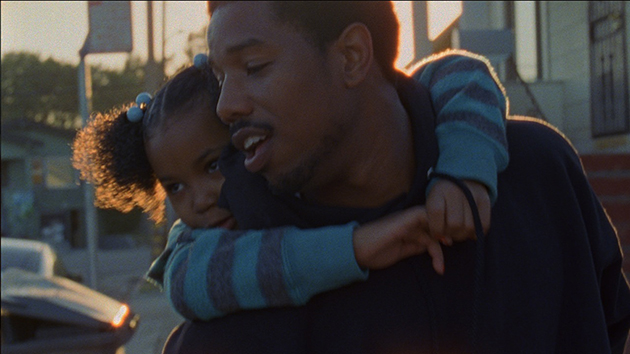
FRUITVALE STATION (2013, Ryan Coogler)
Few directorial debuts have garnered as much attention as Ryan Coogler's Fruitvale Station, which won the top prize at Sundance as well as a huge amount of relevancy in the wake of the Trayvon Martin shooting. The film, which was just recently released nation-wide, tells the story of Oscar Grant, a young man who was unjustly shot by police early on New Year's Day. That is no spoiler, as the film assumes you know the story, which was national news a few years ago, and how the film markets itself as the last few hours in a man's life.
Dealing with such an intimate and real-life situation such as Oscar Grant's death requires a great amount of polished talent to make the story dramatic and interesting. Coogler just doesn't have it, although he certainly shows flashes of potential. Too often the film aims too low, and the first hour simply shows how nice of a guy Oscar Grant is. Sure, he was a drug dealer and was in prison, but he's over that! In a particularly ridiculous early scene, Grant pets a dog at a gas station, and moments later when the dog is hit by a car, we see Grant moan and cry. Coogler is prodding us to go "Look, he cried about a dog, how nice!" Coogler seems unconfident that an audience would accept a former convict as a nice guy, so he pads the film with all sorts of ridiculous scenes showing off how damn nice this guy is, bluntly telling us rather than showing anything. However, despite the weaknesses of the writer-director, Michael B. Jordan does a fairly good job, especially given his hokey material.
The cinematography is also a major issue, as Coogler and his D.P. resort to the current mark of current low-budget cinema- sloppy shallow focus. Fruitvale may be a prime example of the aestetic, where the D.P. shoots mainly in closeup and occasionally shifts focus for no reason (well, his reasoning is to show the "distorted nature of the scene", but really, it just looks cool. It's typically totally unneeded.) Nichol's Mud is another prime example of poor usage of this technique, while Ciranfrance's A Place Beyond the Pines uses it exceptionally well, shooting characters behind patterns and structures, letting the textures and not the open area be blurred.
After an hour of Lifetime Movie-grade fluff, the film slowly grows into its own during a short, energetic scene of Oscar and his friends having a good time. The film shows a more realistic side of Oscar, as he's not helping people at every turn and talking to old women playing with flowers.
The climax, where Oscar is shot, also carries a certain energy to it, and is well-shot and acted. Here, the film is at its absolute strongest. The sequence is heavily indebted to Spike Lee's Do The Right Thing, which still stands on its own. Afterward, we are truly kept in suspense through realistic operation scenes, but ultimately, the film whithers back to its sentimental roots. After a long speech by his mother that any viewer could see coming forty minutes ago, we see Oscar playing with his daughter again to an overexposed film. Of course. It's such a typical ending that it robs any emotional climb the last twenty minutes built.
Fruitvale, quite simply, is poor melodrama which refuses to let its characters breathe and its audience watch on its own. The audience is taken by the hand and told directly how nice Oscar was despite his past, as we could never get that without seeing him cry over dead dogs, Grandmas picking flowers, sneaking his daughter fruitsnacks, and weepy mom-alogues. Despite good performance and a few bursts of creative potential, Fruitvale Station is a melodramatic film that insults its audience by hand-feeding them every detail, robbing any possibility of true drama and intrigue.
Friday, July 26, 2013
SPING BREAKERS (Harmony Korine, 2013)
Harmony Korine, the low budgeted, inventive, and likely crazy auteur known for semi-experimental films such as Julien Donkey-Boy, Gummo, Mr. Lonely and Trash Humpers shocked the film community by announcing Spring Breakers, utilizing several former Disney stars and documenting a Spring Break party lifestyle.
Even though it still had a small budget, the film drew in many high-profile stars, such as former Disney products Selena Gomez (who still has ties with the mouse, so plays the moral center of the group), and Vanessa Hudgens, as well as ABC Family star Ashley Benson. The girls, along with Rachel Corine, are "typical" college girls who declare that they need a break from getting drunk and high at school by getting drunk and high in Florida, and to raise funds, rob a restaurant.
Korine already is presenting something atypical and unexpected, even to those who think they know what they are getting in to. The structure itself is especially bizarre, since the plot focuses on the group on break at first, before even introducing the main catalyst of the plot, Alien.
The editing style is particularly noteworthy, as it often functions in an upfront and direct manner. Honestly, it is hard for me to explain in words what Korine does, but I can compare it to Dennis Hopper's work on Easy Rider, where he flashes several images to bridge scenes, and in one instance, shows an event well into the future. Korine plays with the chronology frequently, for example, showing a character bleeding and crying from a gunshot wound before the shot is even fired.
The film at a whole is just very strange, starting from its story and language. The film operates very symbolically and covertly, often color coding the information and working in layers of meaning. However, sometimes the story can be just much too blunt and straightforward by how absurd the images and characters are supposed to be, yet it doesn't give the sense it even know it.
The film's biggest star arrives nearly halfway through the film in James Franco, playing a crazy drug dealer, Alien, who very well could be a stand in for Korine himself, injecting a level of chaos and insanity into the already bizarre adventures of our main characters while we can practically hear Harmony Korine cackle off screen.
Alien certainly brings the issue of good and evil into our minds, but why? We already know what the girls are capable of after the early robbery. Perhaps we are meant to see how low they went, and how some of them will attempt to escpae, drawing out of the chaos. Morality? Injury? Both play a role in some of the girls' insistance to stop the experiment. The film represents how different people react when a situation is escalated to absurd extremes, yet is less of a character piece than it is a study of the "party" mindset that thrives in many youths. Spring Breakers can sometime be a bit meandering and sometimes too spoken-out and obvious, but it is truly beautifully and originally shot, and offers up a fresh take on college films, in a way that certainly isn't intended for its subjects.
Friday, July 19, 2013
STORIES THEY TELL (Sarah Polley, 2013)
Sarah Polley's personal documentary Stories We Tell draws off of many influences, yet comes up with something truly original. Obviously Polley drew off a wide array of documentaries such as Capturing the Friedmans, Nobody's Business, and the works of Errol Morris, such as Thin Blue Line. Polley blends documentary and fiction in a twisting tale of domestic drama that makes us question commonly regarded facts of our own lives and always puts into doubt what we are seeing.
Polley tells the story of her family, specifically her late mother, and her conception from an extra-martial affair. The story tells like a thriller, and every person has a unique angle to add- "both" of her fathers (biological and adoptive), siblings, and friends of her mother. The story is fresh and very interesting, despite being so personal, which usually does not make for good cinema. In reality, as the end reveals, Polley originally did not think this would be a publicly released feature.
The way Polley compiles the film is truly fascinating. She conducts interviews with her family and friends in a playful manner, but when needed, can ask direct questions. Since we hear her questions, it is a prime example of how to conduct an interview with people you actually know- let them speak, be kind, but keep them focused and on track.
Much of the film consists of "found footage." In reality, while some of it is legitimate, much is freshly shot footage on 16mm film. Actors were hired to play her younger family members, and in a particularly great sequence near the end, we see footage of Polley directing her family. Consistent with the real footage, there is no sound, and narration covers the reenactments, even in a reenacted scene that took place less than 10 years ago- where there was no reason to use 16mm or shoot without sound. I'm not complaining about a lack of authenticity, but simply marveling at the style Polley used.
Polley also uses a scripted, rehearsed, and professionally recorded story that her adoptive father, who she still calls Dad, written with a developed literary flair. The shows Michael Polley in the recording studio and also runs footage over his narration, which is distinct from his interview. Sarah often instructs her father to read back lines, breaking our immersion in the film in a even more captivating way. Stories We Tell is a shining example of the successes when one makes a self-aware, conscious film.
However, the film is really far from perfect. The last act drags on much to long- we know who her father is, we know how both families react, and we see reactions to the film, by this point. However, the film drags on and on, falsely sending about 5 times. Oh, there's a fade to black. Here's the end. Nope. Oh, a long pop song and we see every family members reaction, this is it. Nope. Okay, a touching monologue by her father, there's no way in hell this can continue, right? Wrong. I usually don't get bored in films, but really, the last third dragged on for infinity, and it was marginally entertaining at least. Most of it could be completed cut without any loss to the plot, and it was just frustrating to sit through. However, it really can't destroy the power and genius of the proceeded Hour and a half, but really tries its best.
Despite that, Stories We Tell is a great, innovative documentary. Polley uses the form of film to her advantage to tell a captivating story that can only be told, at least this effectively, through film, bringing in many different modes to tell her story. The film is destined to be screened in film classes until the end of time, and I mean that in a good way. I just feel bad for the students around the hour-thirty mark.
Wednesday, July 10, 2013
DJANGO UNCHAINED (2012, Quentin Tarantino)
The reputation of Quentin Tarantino is certainly glowing. After his 1994 hit Pulp Fiction, Tarantino has experimented with various genres, although sticking to his typical style. However, Tarantino's career has been slipping, and a statement which not many would agree. He followed Pulp Fiction with the genre caper Jackie Brown, and while it's certainly good, it's nowhere near Pulp Fiction's ambitious style and flair. However, it doesn't really even try to be, and Tarantino plays it somewhat traditional.
Tarantino followed with Kill Bill and Death Proof, which I lump together, but not many would. Personally, I prefer Death Proof to the Kill Bill films. Kill Bill is popcorn cinema in disguise. The popcorn aspect is not the problem- that's what make Death Proof so enjoyable. The disguise is where my concern lies, as it is essentially a pair of Groucho glasses. Tarantino ropes us along for three hours in a fake blood extravaganza, yet the film is so self aware, its essentially a parody. But then Tarantino layers it with lofty, lengthy conversations about seemingly nothing- a trademark of his style, but it's out of place and pointless here.
Tarantino followed with Inglourious Basterds, which is a return to form to Pulp Fiction quality. Yes, it's violent, over the top, and absurd, but now, there's a point to it. Tarantino mocks historical and war films, the winning sides treatment of history, and war and violence at a whole. It's a ton of fun, but it also packs a lot of meaning to it.
Django, frankly, is a two hour mess that has no idea what it is trying to do. While the cinematography is great, that's about the only thing it has going. Tarantino tops Kill Bill in regards to self parody and overall confusion of tone, while his Oscar-winning screenplay is just an overloaded mess. Additionally, the absence of the late Sally Menke is certainly felt in the editing room, robbing Tarantino of his style's fluidity The first hour of the film is downright meandering, which honestly isn't even a bad thing, but so much time is wasted by backstory details.
Tarantino's fixation with fake blood and over the top, just distracting violence continues as endless hordes of baddies are shot by Jamie Foxx's dully portrayed Django. Foxx just floats from scene to scene, adding very little depth to the character, showing one emotion: a flat, monotone anger. The screenplay, which bafflingly won an Academy Award, is just tired and uneven, and is the film's greatest flaw. The pace is completely uneven, and the film kills its momentum with about forty minutes to go. The conclusion is completely boring and utterly predictable. Django's plan for recapturing his love is completely over plotted and over-complicated, with tons of holes forming in his, and Schultz, Django's partner in bounty hunting, reasoning in logic. Holes and logic, if not explainable by character, are just a sign of poor writing, and their is no reason Django would find this plan acceptable. The editing is just the final nail in the coffin for Django Unchained. The film just feels choppy, and its assembly allows one to see the duct tape holding it together. So much just feels out of place, and the rapid fire of shots in one of the many action scenes just comes off as overdone and ineffective.
Leonardo DiCaprio an Christoph Waltz certainly are the film's greatest assets. Waltz, who won an Oscar for his gentleman bounty hunter, returns with as many dry and snarling quips as in Basterds but now applies them to a decent human being, with interesting results. We have a similar character, but only with mainly good intentions. DiCaprio is good, but far from great, in his over the top portrayal of a false gentleman slave owner. DiCaprio is just distracting at times, but still shines, yet occasionally doesn't fit in the world Tarantino creates, just another inconsistency in Django.
Django Unchained is perhaps Tarantino's weakest film, a title it almost shares with Kill Bill. The two (or three) film's share many similarities- neither know what they really want to do, and as a result, are rambling and totally inconsistant.
Monday, July 1, 2013
BEFORE MIDNIGHT (Richard Linklater, 2013)
Before Midnight, likely the final film in an outstanding romantic trilogy by off-beat auteur Richard Linklater, resembles Linklater's other films more than it resembles its predecessors- Before Sunrise and Before Sunset. Jesse and Celine are certainly at the forefront, but Linklater focuses more on other characters than the two lovers, like his sprawling, open films like Slacker, Dazed and Confused, and Waking Life, just to name a few.
As a result, the first act begins to lag (after two scenes, involving a Jesse dropping his son off, and a long drive back to their Greek country house). Personally, Linklater's writing style- involving multiple characters dropping huge words and "inherent truths" and philosophies comes off as pseudo-intellectual and simply full of itself. The characters say all they want, but they don't really mean anything. Although the scene where Jesse discusses concepts for a novel is at least interesting, albeit slightly overdone, the following segment involving a table full of Linklater stock characters discussing love and relationships seems to go on forever and drys up an momentum the film had. Jesse and Celine eventually leave on their own, and essentially, must rebuild the film's tone.
However, they certainly do so quickly, as Before Midnight recovers as Jesse and Celine walk the streets of Greece, in a scene that instantly recalls the earlier two films. For the first time, the two are truly alone, and are now back on the streets of Europe, where we first saw them twenty years ago. The couple arrives at their hotel, at which point the film's tone slowly shifts from the relaxed discussion recalling the first two films to an emotionally intense hour of name called, secrets, accusions, and a total lack of rationality.
Truthfully, I really don't want to spoil anything. However, I need to point out the conflict of gender the film puts forward. I'm sure 90% of men will sympathize with Jesse as he tries to combat the "Mayor of Crazy Town," while I think most women will realize Celine's concerns and how quickly Jesse rebuffs them. The film itself drops its viewers into the argument and almost forces them to take sides.
Before Midnight blossoms into a very good film, although not rising to the spectacular heights of the original film from 1995. All three are exceptional, but the first and the last are clearly the strongest- perhaps because they capture a definitive period of time. Sunrise is youth, where we do not care to look into the future, while in the middle age of Midnight we must. Sunset is the odd transition period, where it is really only clear to us that this is a permanent change, and the characters do not. Perhaps the reason I prefer the first film is because of my age- at 20, I relate much more towards the young, idealistic Jesse and Celine, who refuse to exchange numbers out of the principal, not realizing the heartbreak it will cause in the future. In Midnight, they must truly break down their idealism and address their true desires.
Friday, June 28, 2013
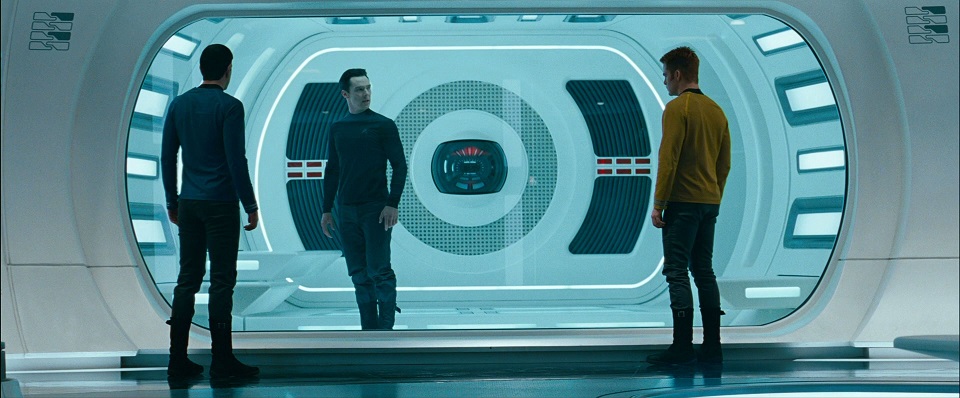
STAR TREK INTO DARKNESS (2013, JJ Abrams)
Honestly, I've ranted about new major blockbusters a lot. So perhaps it seems a bit odd that I'm going to take on a high budgeted sequel to a major franchise. Into Darkness truly shocked me, and not even in an ironic way. EVen though the 2009 reboot of the series was good, Into Darkness trumped it in nearly every way imaginable, creating a smarter, tighter, more exciting film all around.
Into Darkness delivers on its title, and delivers a much more morbid film, as much of it is focused around death- reactions and fears. Spock is externally fearless through his rational approach, but internally thinks about his demise and the demise of his friends as much as Kirk, who does not lack the emotional restraint. Kirk makes several brash decisions in order to avenge his fallen mentor, but ultimately will not let his rage betray his morality.
All three leads- Chris Pine (Kirk), Zachary Quinto (Spock) and Benedict Cumberbatch ("John Harrison")- excel in their roles and carry the film. JJ Abrams style fits the film like a glove, and I personally felt that his often mocked lens flares fit the style and content, definitely leaving a futuristic, other-worldly touch to the film.
Narratively, the script is an air-tight two hours, leading its audience to different planets and developments naturally, working equally well whether Spock and Kirk are together or separated. The films up and downs are marvelous, seeming to climax several times with knock-out drag-out action sequences frequently. But even without them, the film thrives. The do not carry a soggy storyline, but rather work with it, like strawberries in cereal. You like the cereal anyway, but the strawberries are damn good in it.
Perhaps the weakest moment of the film is the appearance of Leonard Nimoy- an older Spock from another universe, returning from the first film (even though he told his younger self they can never meet again). The entire scene is problematic- First, it's kind of dopey how Spock contacts his older self to begin with- it appears he just calls him. Second, and by far the biggest problem- Old Spock adds nothing to the film. He simply confirms to the audience (and the crew) that the main antagonist is evil, something already well-known. In fact, even without this information, Kirk prepares to disable the villain immediately after working with him. Young Spock asks his older self how the villain was defeated, and the scene cuts. We don't know what Spock says, but how on earth would Old Spock have any information about the current situation? Sure, the ending is a reverse of one of the original Star Trek films, but Spock does nothing to cause that. The entire appearance is like Nimoy wanted to be in the film, and the producers simply didn't have the heart to say no, so they wrote him into an already completed script.
But despite that one weakness, Star Trek Into Darkness is an exceptional piece of big budget Hollywood filmmaking- It's smart and covers some heavy themes without being pretentious, heavy-handed, or downright shallow, it's thrilling, and above all, it's just a lot of fun and is just a total rush.
Wednesday, June 26, 2013
ZERO DARK THIRTY (2012,Kathryn Bigelow) and the issues of Cerebral films
Zero Dark Thirty, released several months ago to significant critical acclaim, continued Bigelow's career in the direction she paved with 2008's The Hurt Locker. Zero Dark Thirty follows Maya, a young CIA analyst who becomes obsessed with finding Osama bin Laden. I saw the film on it's initial release, and have not had the chance to watch it again, but the film truly stuck in my head- and not in the good way.
ZDT follows an unfortunate trend of films that have received very good reviews despite very poor plotting and writing in general. These films are labeled cerebral, not in the sense that they make you think, but that they utilize only their heads, and are over-plotted and ultimately heartless. Sidney Lumet used this term in his book Making Movies, but it has been used in other sources as well. Zero Dark Thirty is at the heart of the resurgence of this trend, with films like Michael Clayton and Tinker, Tailor, Soldier Spy. All the films listed have several shared characteristics- long lengths, overly complex plots that are essentially impossible to follow, and ultimately resulting in a film that is all about the plot and has no time for character development or heart.
In almost three hours, Bigelow's film covers a ten-year period, sending Maya all over the globe, and constantly introducing characters and plot lines. But we really know nothing about Maya, which is the issue. The film leaves no time to really show her, and as a result she is a background to the complexities of the script. It's like the writers attempted to show how smart they were, and they do end up with a tight knot of a story, but Maya is just a pawn. We know she is totally devoted to her career and has little time for anything else, but in doing so, we neither know her or care about her.
Every issue in the film comes to light at the conclusion. Osama Bin Laden is killed in the covert mission, where Maya is taken offscreen for nearly thirty minutes. The scene is intense and exceptionally well-done, to the point where its failings in character vanish. It is a suspenseful, well-crafted action sequence that is the obvious strength of the film. However, the film is weakened by its conclusion, where we return to Maya at the base. It attempts to show the film's point, but ends up simply grasping out towards the air. Its hands close around nothing, yet it tries to present us with its find. We just see an empty hand.
Bin Laden's body is presented to Maya. She asks to be left alone, and over the terrorists body, she weeps. But why? For the loss of her friends who were killed by his organizations? For the loss of her life in ten years hunting a man? For the loss of Bin Laden's life? Because she finally realized all those monkeys died? We have no idea, and we were given no clues. Most people will say that she cries for the years wasted, but we have no indication she feels that way. We see so little of her true self, as she is always consumed by the twists and turns of the plot, to the point where she is suffocated.
But the worst is not the fact we do not know why she weeps, but that really, we don't care. We don't know or like Maya at all. And thus, the film ends attempting to touch us emotionally, but fails miserably. Zero Dark Thirty's biggest flaw is that its maze of a plot swallows any characters that are being grown.
Monday, June 24, 2013
FRANCES HA (2013, Noah Baumbach)
Noah Baumbach is best known for his quick and witty dialogue, where characters use inflated vocabularies but still sound natural (or at least fitting to the character). This is best scene in his films Kicking and Screaming, Squid and the Whale, Greenberg, and his screenplay collaborations with Wes Anderson (Life Aquatic and Fantastic Mr. Fox). Anderson and Baumbach are typically compared to one another due to their work together, but in reality, there is no reason to compare them. Sure, both are "quirky," but in totally different ways. Anderson paints technicolor pictures (literally with his images and figuratively by his story lines), while Baumbach has always carried a cynical edge to his work. Anderson can stray to darker topics from time to time but always comes back to pop songs and sunshine. Baumbach's stories typically have greater emotional depth and do not emphasize the superficial composition.
Baumbach's latest work, Frances Ha, is certainly a comedy, consistant with most of Baumbach's works, but is not afraid of looking into the void of a future that possibly awaits Frances, our 20-something New Yorker. The film follows Frances as she resists change in her life. Her best friend becomes more and more committed to the type of guy they used to make fun of for his distressed baseball caps, her low-paying job at a dance studio is going nowhere, and she can't sem to find a solid place to live. The film's major external motion is Frances moving from apartment to apartment, finding new roommates and living situations, trying to grow up and find stability.
However, Frances doesn't really have any intention of growing up, it seems. In the film's opening, she leaves her boyfriend because she does not want to leave her best friend Sophie alone in an apartment, and never contacts her ex again, even though Sophie soon moves out. For her career, she turns down a valuable opportunity to work as an assistant to the dance school's director out of an odd mix of pride and refusing to change career directions. However, right after rejecting that job, she accepts a position as a college tour guide at her alma mater, showing that she was ready to accept "failure" to herself, but not publicly yet.
Greta Gerwig is phenomenal as the wandering 20-something. Although self-importantly quirky characters are hopefully a thing of the past, since they typically have zero depth besides doing something silly and inappropriate (think Zooey Deschanel in many of her roles, Natalie Portman in Garden State, and even Gerwig herself in last year's disastrous Damsels in Distress), Frances has obvious reasons working behind her actions. When she dances while running in the street, we know why.
Perhaps the most interesting aspect of Frances Ha is the heavy stylistic similarities between it and French New Wave films. Baumbach seems to have drawn from a mix of Goddard and Truffaut in particular. Although Truffaut's wanderlust in regards to story and structure is obvious throughout the film, I felt the presence of Goddard heavily during a later scene in the film, in which a drunk Frances delivers a lengthy but well-crafted monologue about the nature of love, and how one hopes to find it. The speech's placement just reeked of Goddard, and truly allowed all the pieces of the film to fall into place. France's idealistic view on love that she presents tampers with not only her romances but all other aspects of life- friendships, careers, and dreams.
Frances Ha is certainly a unique film, filled with alternating fear and hope for the future. Baumbach, now in his forties, gracefully enters the life of someone much younger than him and without any clear prospects, yet as an outsider, gently diagnoses her and allows the audience to see her flaws. However, he does not judge, and allows her to learn, succeed, and ultimately grow into her own person and create her own opportunities and success. Frances Ha is a brillant tribute to fading youth, New Wave, and the fear of an unknown future
Labels:
Baumbach,
Gerwig,
new movie,
review,
Wes Anderson
Wednesday, June 12, 2013
MUD (2013, Jeff Nichols)
No introduction needed, I guess, besides this. Not only is this the first Eye Slice review, this is the first article. I'm going to try to create new content at least three times a week- Monday, Wednesday, Friday. But who knows. So, let's start with a new film, Jeff Nicols Mud.
Mud debuted at Cannes 2012, but only received a wide American release in the last few weeks. Mud has been praised widely, like Nichols previous effort Take Shelter. Take Shelter showed the new director's promise, despite a flawed third act and conclusion that ultimately muddled the message Nichols tried to convey.
Mud immediately has several things going for it. Nichols's strongest attribute appears to be building an immersive environment, and Mud is no exception. We explore the deep south through the eyes of two young boys, in a modern environment, but not tied to one moment in time. In this aspect, it resembles a Mark Twain story. Nichols's fingerprints can be seen in every frame of the film, but it is still completely relatable.
Matthew McConaughey is as good as the often derided actor has ever been. He creates the love-sick exile warmly, building his character slowly, but leaving much open for interpretation and a deeper reading. The young Tye Sheridan excels as the impressionable, confused Ellis, susceptible to facing a similarly grim future as Mud, who runs from gangsters and the police after killing a "connected" man for beating Mud's love, Juniper (Reese Witherspoon).
However, as the film progresses, it weakens substantially. the biggest issue lies with the central romance, between Mud and Juniper, which is vastly uninteresting and says nothing of note about love, family, or romantic disinterest, themes that come from the other two relationships depicted in the film- the faltering marriage of Ellis's parents, and Ellis's courtship of a high school girl several years older than him. Both relationships are much more dynamic and interesting than Mud and Juniper, which falls flat quickly, doesn't progress and ultimately passes on as an afterthought, and kills much of the film's story, especially the second act.
The chief antagonists of the film are similarly bland: a squad of generic gangsters led by the brother and the father of the man Mud killed. However, the gangsters seem like another afterthought to Nichols, as they are simply a mechanical creation used to move the plot, and say absolutely nothing about any of the themes or messages of the film. When the storyline comes to a close, it doesn't satisfy in the slightest, since there is no real fear from the gangsters, or even interest in the father and son trying to get their revenge. The film seems to want to say something on violence, but can barely gasp out a word or two on the subject before it is immersed by the ineffective stories around it.
Even the much more interesting dynamic between Ellis's parents resolves sloppily. Nichols's seems completely unsure what the real story he wants to tell is, and what it even all means, so tries to throw several stories on top of one another, hoping one sticks. Actually, Ellis's relationship with high school girl, who the audience immediately knows is uninterested in him romantically, works, but is underutilized and forgotten.
Adam Stone's photography is completely unremarkable, despite several interesting shots of the wilderness. Stone and Nichols compositions are generally shallow and bland. The 35mm print looks digital, in the worst way a film can look so. the focus is constantly shallow, and the blurred, out of focus patterns that often live behind the characters are simply boring.
All in all, Nichols's third film cannot be anything more than a promise of things to come of the young filmmaker. Despite what many proclaim, Jeff Nichols is nowhere near maturity for a filmmaker, although several individual aspects of Mud show potential, but no guarantee of development or future success. Mud certainly represents a step back from Nichols previous efforts.
Bottom line: Despite a stunning environment and several brillant performances, Mud fails to come together and ultimately falls flat due cliches and poor story telling.
Labels:
jeff nichols,
mcconaughey,
Mud,
new movie,
review,
witherspoon
Subscribe to:
Posts (Atom)