Showing posts with label jeff nichols. Show all posts
Monday, July 29, 2013
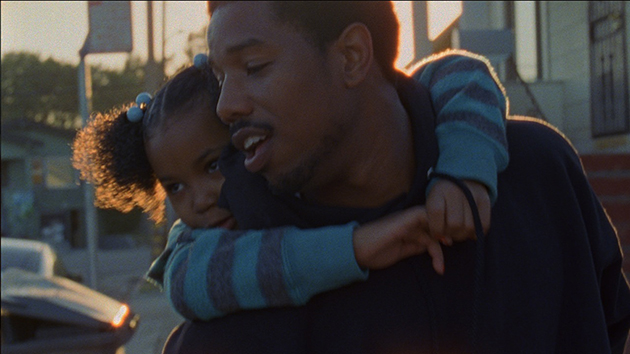
FRUITVALE STATION (2013, Ryan Coogler)
Few directorial debuts have garnered as much attention as Ryan Coogler's Fruitvale Station, which won the top prize at Sundance as well as a huge amount of relevancy in the wake of the Trayvon Martin shooting. The film, which was just recently released nation-wide, tells the story of Oscar Grant, a young man who was unjustly shot by police early on New Year's Day. That is no spoiler, as the film assumes you know the story, which was national news a few years ago, and how the film markets itself as the last few hours in a man's life.
Dealing with such an intimate and real-life situation such as Oscar Grant's death requires a great amount of polished talent to make the story dramatic and interesting. Coogler just doesn't have it, although he certainly shows flashes of potential. Too often the film aims too low, and the first hour simply shows how nice of a guy Oscar Grant is. Sure, he was a drug dealer and was in prison, but he's over that! In a particularly ridiculous early scene, Grant pets a dog at a gas station, and moments later when the dog is hit by a car, we see Grant moan and cry. Coogler is prodding us to go "Look, he cried about a dog, how nice!" Coogler seems unconfident that an audience would accept a former convict as a nice guy, so he pads the film with all sorts of ridiculous scenes showing off how damn nice this guy is, bluntly telling us rather than showing anything. However, despite the weaknesses of the writer-director, Michael B. Jordan does a fairly good job, especially given his hokey material.
The cinematography is also a major issue, as Coogler and his D.P. resort to the current mark of current low-budget cinema- sloppy shallow focus. Fruitvale may be a prime example of the aestetic, where the D.P. shoots mainly in closeup and occasionally shifts focus for no reason (well, his reasoning is to show the "distorted nature of the scene", but really, it just looks cool. It's typically totally unneeded.) Nichol's Mud is another prime example of poor usage of this technique, while Ciranfrance's A Place Beyond the Pines uses it exceptionally well, shooting characters behind patterns and structures, letting the textures and not the open area be blurred.
After an hour of Lifetime Movie-grade fluff, the film slowly grows into its own during a short, energetic scene of Oscar and his friends having a good time. The film shows a more realistic side of Oscar, as he's not helping people at every turn and talking to old women playing with flowers.
The climax, where Oscar is shot, also carries a certain energy to it, and is well-shot and acted. Here, the film is at its absolute strongest. The sequence is heavily indebted to Spike Lee's Do The Right Thing, which still stands on its own. Afterward, we are truly kept in suspense through realistic operation scenes, but ultimately, the film whithers back to its sentimental roots. After a long speech by his mother that any viewer could see coming forty minutes ago, we see Oscar playing with his daughter again to an overexposed film. Of course. It's such a typical ending that it robs any emotional climb the last twenty minutes built.
Fruitvale, quite simply, is poor melodrama which refuses to let its characters breathe and its audience watch on its own. The audience is taken by the hand and told directly how nice Oscar was despite his past, as we could never get that without seeing him cry over dead dogs, Grandmas picking flowers, sneaking his daughter fruitsnacks, and weepy mom-alogues. Despite good performance and a few bursts of creative potential, Fruitvale Station is a melodramatic film that insults its audience by hand-feeding them every detail, robbing any possibility of true drama and intrigue.
Wednesday, June 12, 2013
MUD (2013, Jeff Nichols)
No introduction needed, I guess, besides this. Not only is this the first Eye Slice review, this is the first article. I'm going to try to create new content at least three times a week- Monday, Wednesday, Friday. But who knows. So, let's start with a new film, Jeff Nicols Mud.
Mud debuted at Cannes 2012, but only received a wide American release in the last few weeks. Mud has been praised widely, like Nichols previous effort Take Shelter. Take Shelter showed the new director's promise, despite a flawed third act and conclusion that ultimately muddled the message Nichols tried to convey.
Mud immediately has several things going for it. Nichols's strongest attribute appears to be building an immersive environment, and Mud is no exception. We explore the deep south through the eyes of two young boys, in a modern environment, but not tied to one moment in time. In this aspect, it resembles a Mark Twain story. Nichols's fingerprints can be seen in every frame of the film, but it is still completely relatable.
Matthew McConaughey is as good as the often derided actor has ever been. He creates the love-sick exile warmly, building his character slowly, but leaving much open for interpretation and a deeper reading. The young Tye Sheridan excels as the impressionable, confused Ellis, susceptible to facing a similarly grim future as Mud, who runs from gangsters and the police after killing a "connected" man for beating Mud's love, Juniper (Reese Witherspoon).
However, as the film progresses, it weakens substantially. the biggest issue lies with the central romance, between Mud and Juniper, which is vastly uninteresting and says nothing of note about love, family, or romantic disinterest, themes that come from the other two relationships depicted in the film- the faltering marriage of Ellis's parents, and Ellis's courtship of a high school girl several years older than him. Both relationships are much more dynamic and interesting than Mud and Juniper, which falls flat quickly, doesn't progress and ultimately passes on as an afterthought, and kills much of the film's story, especially the second act.
The chief antagonists of the film are similarly bland: a squad of generic gangsters led by the brother and the father of the man Mud killed. However, the gangsters seem like another afterthought to Nichols, as they are simply a mechanical creation used to move the plot, and say absolutely nothing about any of the themes or messages of the film. When the storyline comes to a close, it doesn't satisfy in the slightest, since there is no real fear from the gangsters, or even interest in the father and son trying to get their revenge. The film seems to want to say something on violence, but can barely gasp out a word or two on the subject before it is immersed by the ineffective stories around it.
Even the much more interesting dynamic between Ellis's parents resolves sloppily. Nichols's seems completely unsure what the real story he wants to tell is, and what it even all means, so tries to throw several stories on top of one another, hoping one sticks. Actually, Ellis's relationship with high school girl, who the audience immediately knows is uninterested in him romantically, works, but is underutilized and forgotten.
Adam Stone's photography is completely unremarkable, despite several interesting shots of the wilderness. Stone and Nichols compositions are generally shallow and bland. The 35mm print looks digital, in the worst way a film can look so. the focus is constantly shallow, and the blurred, out of focus patterns that often live behind the characters are simply boring.
All in all, Nichols's third film cannot be anything more than a promise of things to come of the young filmmaker. Despite what many proclaim, Jeff Nichols is nowhere near maturity for a filmmaker, although several individual aspects of Mud show potential, but no guarantee of development or future success. Mud certainly represents a step back from Nichols previous efforts.
Bottom line: Despite a stunning environment and several brillant performances, Mud fails to come together and ultimately falls flat due cliches and poor story telling.
Labels:
jeff nichols,
mcconaughey,
Mud,
new movie,
review,
witherspoon
Subscribe to:
Posts (Atom)