Showing posts with label race. Show all posts
Monday, July 29, 2013
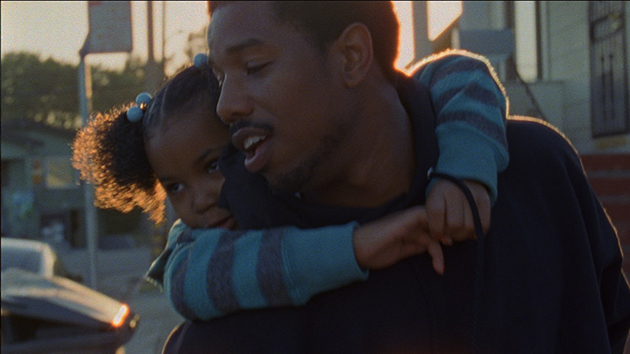
FRUITVALE STATION (2013, Ryan Coogler)
Few directorial debuts have garnered as much attention as Ryan Coogler's Fruitvale Station, which won the top prize at Sundance as well as a huge amount of relevancy in the wake of the Trayvon Martin shooting. The film, which was just recently released nation-wide, tells the story of Oscar Grant, a young man who was unjustly shot by police early on New Year's Day. That is no spoiler, as the film assumes you know the story, which was national news a few years ago, and how the film markets itself as the last few hours in a man's life.
Dealing with such an intimate and real-life situation such as Oscar Grant's death requires a great amount of polished talent to make the story dramatic and interesting. Coogler just doesn't have it, although he certainly shows flashes of potential. Too often the film aims too low, and the first hour simply shows how nice of a guy Oscar Grant is. Sure, he was a drug dealer and was in prison, but he's over that! In a particularly ridiculous early scene, Grant pets a dog at a gas station, and moments later when the dog is hit by a car, we see Grant moan and cry. Coogler is prodding us to go "Look, he cried about a dog, how nice!" Coogler seems unconfident that an audience would accept a former convict as a nice guy, so he pads the film with all sorts of ridiculous scenes showing off how damn nice this guy is, bluntly telling us rather than showing anything. However, despite the weaknesses of the writer-director, Michael B. Jordan does a fairly good job, especially given his hokey material.
The cinematography is also a major issue, as Coogler and his D.P. resort to the current mark of current low-budget cinema- sloppy shallow focus. Fruitvale may be a prime example of the aestetic, where the D.P. shoots mainly in closeup and occasionally shifts focus for no reason (well, his reasoning is to show the "distorted nature of the scene", but really, it just looks cool. It's typically totally unneeded.) Nichol's Mud is another prime example of poor usage of this technique, while Ciranfrance's A Place Beyond the Pines uses it exceptionally well, shooting characters behind patterns and structures, letting the textures and not the open area be blurred.
After an hour of Lifetime Movie-grade fluff, the film slowly grows into its own during a short, energetic scene of Oscar and his friends having a good time. The film shows a more realistic side of Oscar, as he's not helping people at every turn and talking to old women playing with flowers.
The climax, where Oscar is shot, also carries a certain energy to it, and is well-shot and acted. Here, the film is at its absolute strongest. The sequence is heavily indebted to Spike Lee's Do The Right Thing, which still stands on its own. Afterward, we are truly kept in suspense through realistic operation scenes, but ultimately, the film whithers back to its sentimental roots. After a long speech by his mother that any viewer could see coming forty minutes ago, we see Oscar playing with his daughter again to an overexposed film. Of course. It's such a typical ending that it robs any emotional climb the last twenty minutes built.
Fruitvale, quite simply, is poor melodrama which refuses to let its characters breathe and its audience watch on its own. The audience is taken by the hand and told directly how nice Oscar was despite his past, as we could never get that without seeing him cry over dead dogs, Grandmas picking flowers, sneaking his daughter fruitsnacks, and weepy mom-alogues. Despite good performance and a few bursts of creative potential, Fruitvale Station is a melodramatic film that insults its audience by hand-feeding them every detail, robbing any possibility of true drama and intrigue.
Monday, July 15, 2013
DO THE RIGHT THING (Spike Lee, 1989) and Trayvon Martin
With the events of the past few days involving the Trayvon Martin-George Zimmerman trial, it only feels natural to discuss this film, and what it implies for race in America, and what it really means in relation to the trial. I've already heard it mentioned in regards to the "Not Guilty" verdict, a comparison I believe is wholly inaccurate.
First, let's discuss the film's construction at a whole, trying to keep it spoiler free. Do The Right Thing, along with 12 Angry Men, uses heat in such a visible way to keep the tension high and rising that it is practically a character. People are quicker to anger, and speak more directly than they probably should. Lee's character Mookie walks around a Brooklyn neighborhood delivering pizza, trying to stay cool, physically and emotionally, as a minor protest is formed in front of Sal's pizzeria where he works, based on the race of the members of "the wall of fame."
Race rears its head in many ways- ownership of the neighborhood, interracial romances, and racial ownership of ideas. But as the film progresses, its clear that Lee sees the world as Asians, African-Americans, Hispanic, and etc. against the white community. Sure, like the United States, whites are outnumbered in the neighborhood, but they still hold the power. The have the businesses. They have the antique brownstones. The still are the the power. For the record, as a white man, I completely belive this is true, and is even more confusing recently than it ever is. Black culture has been for nearly 100 years the cool scene in America, yet those that dictate the in, the cool, and the now are mainly white, and are very influenced by the caucasian power.
The film builds as the heat rises in Brooklyn, and its climax falls just after sunset. A fight ends with police intervention and the murder of a young black man. Silence cuts through the street. Eyes are on Sal, who started the fight with racial slurs and insults. And then, Mookie, our relatable, likable, kindly hero, picks up a trashcan and hurls it through the window of the pizzeria- the crowd follows his action, and soon the pizzeria is a pile of ashes. Audiences are often repelled by the action, mainly because Mookie is the film's hero, and is definitely seen as a good person. But in the end of the day, its a pizzeria against a human life, and not just that, a human life that ended moments before, and one of Mookie's best friends.
And it saddens me to hear this iconic and poignant scene in cinema brought up with the Martin-Zimmerman verdict. There are superficial similarities- neither victim was truly innocent, but neither deserved to die. That's not even debatable in my mind. But now with the verdict? It is true Justice. We don't always get it. The world is a complicated place with complicated laws. I believe in the American Justice system, and it states that one must be guilty without reasonable doubt. There was doubt, twelve random citizens decided. And he is free.
And you may not like it. But what do you know? Really, how do you know about this case? You only know what you are told. The jury has received the details of the case undiluted, without any bias, and thus they possess better judgment than anyone else hearing months of opinionated releases. It is still devastatingly sad, but that is all.
Now, I hear people talk about Mookie throwing that trash can, and calling us to throw the trashcan at Zimmerman. Mookie's act was not meditated. There was barely a minute to think, and not months of nonsense reporting feeding him. People argue that Mookie threw the trash can to defend Sal and his sons, but I don't really buy that, not was that Lee's intentions. He threw the can in rage, plain and simple, and a rightful rage at that.
Mookie attacked a store, deciding that human lives were less important. But what are those advocating violence against Zimmerman promoting? They want others to suffer what they feel. They are saying Zimmerman is less important than Trayvon Martin, which is simply untrue. Mookie really did the right thing with his trashcan through the window of Sal's. But action against Zimmerman, or just in the name of Trayvon months later just to make one feel better is just wrong.
Subscribe to:
Posts (Atom)
