Showing posts with label classic review. Show all posts
Friday, August 16, 2013
MEDIUM COOL (Haskell Wexler, 1969)
Hollywood, eternally five years behind culture because of long production schedules, finally caught up to the social revolution in the late 1960's, birthing the New Hollywood movement with films like The Graduate and Easy Rider. Haskell Wexler, famed cinematographer, decided to get to the heart of the issue of America and start a revolution in film at the same time. The film tells the story of a devoted and moral cameraman, John, who is placed amongst real footage.
Medium Cool revolutionary technique was fictional use of cinema verite, blended with real documentary footage that aided the plot, as well as Easy Rider-esque editing and structure. John attempts to get the footage he wants to shoot, not the footage his unscrupulous boss desires so it can be sold to the police and FBI.
The film bluntly states its mission in one of the earliest scenes, which is a long, documentary styled sequence in which a party discusses the merits of television as a medium and the moral responsibilities of a camera man. The opening shows John and his sound cooly looking at a highway wreck, and only after getting footage so they call the police. At the film's abrupt conclusion, we are once again presented the situation. However, Wexler does not give us an answer explicitly, as we must find our own. Should a cameraman be more camera or more man?
The first half is John operating as a camera, going to various locations and filming what he is assigned. However, his humanity undercuts everything, forcing him to focus on a human interest story of a black man who returns money found in the cab. The story is unpopular with the man's friends, who see him as interested in the man because of his race and accuse John of attempting to make a circus out of the act ("Human Interest? Are humans going to be interested by us, or we humans?") while John's television boss finds the story bland, and eventually fires John.
The next half shows John's humanity, undercut with his profession. He falls for a woman, Eileen, with a young son, Harold, who he cares deeply for. John takes a break and falls in love with Eleen, although he stays interested in society. One incredibly scene involved shaky, free footage of a hippie nightclub, using bright colors and odd cuts in harmony.
The film's most memorable scene is the very end, in which Harold runs off while Eileen looks for him amidst the Democratic National Convention Riots. While Eileen is there, we see real footage of police brutality. Wexler predicted a riot at the convention, yet not the fact the police instigated the incident. The riot sequence is more a historial document that a part of the film's narrative, though it feeds the environment and tone of the film. It is edited in such a way that we never forget where we are: The convention, yet still with Eileen. The plot still lives even through the reality of the footage, a feat nearly impossible to pull off.
However, Medium Cool is mainly remembered as a time capsule rather than a work of film. Truthfully, I admire its structure greatly, as well as the risks it took. The film succeeds at its ambitious reach, standing as both a history and a work of art.
Wednesday, August 7, 2013
MONSIEUR VERDOUX (Charles Chaplin, 1947)
Today, Charlie Chaplin is perhaps the most recognizable icon in film history, and at least silent film's most recognizable icon. Chaplin is pretty much only remembered for his tramp character, which he lived under for his entire career. Even his 1940 transition to talking pictures, The Great Dictator, a highly political comedy which satirizes Adolph Hitler, uses a tramp-look-alike, even though Chaplin insisted that this was not the tramp. Chaplin only completely left the charcter behind in the dark comedy Monsieur Verdoux.
Chaplin is the title character, a french family man who, after being left jobless in the stock crash, began to wed and murder wealthy woman, feeling completely justified in his actions to acquire money for his family. The idea was first conceived by Orson Welles, who was very close to directing (and partially writing) the film, but Chaplin grew uncomfortable with the notion of not having total control. Welles later said that his version would have been better, not that Chaplin's was bad. Welles, I believe, was right on both counts.
Chaplin, of course, shows his acting brilliance as Verdoux, and the film shines at several moments. Perhaps the most blatantly hilarious scene involves Verdoux trying to kill a wife while fishing, and failing miserably at every attempt. Some supporting characters, like the family of one of his victims, are just fantastic, as the entire family seems to be completely incompetent.
However, Chaplin was not a great director, and is stuck in the silent era with his flat images and closed spaces. Sure, its not bad, but Welles could have certainly made a more visually interesting film. Chaplin also seemed to struggle with the other side of film creation, not knowing what to do with the story of the actors. The plot of Verdoux's family is woefully underdeveloped, and has zero closure. It's assumed they die, or at least leave, but we never know. They simply evaporate from the film. The beautiful swedish ex-convict has zero development, and we hardly know her. It is fine when Verdoux lets her go, but when she reappears at the film's end, it is hard to care about her now. Another issue lies with the ending. Like the Great Dictator, we have another monologue, this time in the form of a closing court statement, but it now seems detached from the film. Dictator's monologue is seperate from the film as well, but at least has some ties. The sweeping statement from Verdoux, where the character points out society's acceptance of war and soldiers but condemns those that murder "one, instead of millions" is powerful, but oddly inserted.
It is easy to see why Verdoux was unpopular at the time and resulted in a hit to Chaplin's reputation. Not only is the hero a murderer and without remorse, he is anti-religious, anti-war, and anti-nationalist, and is depicted as a certain gentleman. Chapin was later exiled for his communist sympathies, after Limelight. Despite Verdoux's flaws, and the fact that it could have been a masterpiece with a Welles-Chaplin collaboration, it is still a solid and entertaining film.
Labels:
Chaplin,
Classic Film,
classic review,
review
Friday, August 2, 2013
MCCABE AND MRS MILLER
Robert Altman, one of the American masters of cinema, at least in my opinion, made a major impact on the Western genre by essentially grounding it in reality with McCabe and Mrs. Miller, taking several tired cliches, reverting them, and adding in a dose of realism. McCabe, an odd gambler and unconventional hero, attempts to build up a railroad town, bringing in prostitutes, gambling and pubs, turing the quiet snowy land into the quintessential wild west town, drawing eyes from major businesses. Mrs. Miller comes in with her own prostitutes to help McCabe, and the two embark on an ultimately doomed relationship.
The film’s cinematography is absolutely gorgeous, using long takes and slightly overexposed film to give it a washed out, old-time sepia look. The film perfectly utilizes one of my favorite musicians, the incomparable singer-poet Leonard Cohen, using several tracks from his debut album. The rest of the sound, however, is the film’s greatest weakness. It seems Altman and his crew miked every person, then decided to mix the track later, giving it a foggy, muddy noise.
McCabe is essentially a dirt bag, unscrupulous and greedy, but falls for the opium addicted Mrs. Miller, who like-wise falls from him. Warren Beatty and Julie Christie are both fantastic, putting aside their real-life romance to portray two lovers who are completely incompatible.
McCabe dooms himself by attempting to play hard ball with two representatives of a massive corporation, who resent his games and leave before he can accept their offer. The company sends a hulking man with two toughs to end McCabe, but unlike most brutes seen in Westerns, the huge man is sophisticated, intelligent, and suave, easily outsmarting and weakening McCabe psychologically and ruining his reputation in town. Now, McCabe is alone, and must defeat the enemies.
But Beatty is no Gary Cooper, and does not march out into the streets to fight against his foes. McCabe is a weasel, and thus acts like one, or at least the audience would view him as cowardly if expecting a Western. Truthfully, it is just realistic. He shoots his enemies in their back, a major faux pas in Western lore, and sneaks in hide in the fresh falling snow.
Christie, meanwhile, feeds her addiction, and smokes opium while McCabe defeats the leader of the posse, but dies in the process. Ultimately, the film is about the relation between the title characters, and its doomed, incompatible nature, having to end on the definitive note of McCabe dying alone in the snow.
Wednesday, July 31, 2013
LONESOME (Paul Fejos, 1928)
A major flaw with modern audiences' perception of film is the overemphasis on story and audiences' fixation of it even when it is unimportant and only aids a theme. Some films can have great visuals, yet not hold up at all because of the lack of story and the fact that it attempts to make the story important and a true fixture of the film, like a "traditional" film. A film like this would be Tarsem's The Fall, a shallow, stupid film with admittedly lovely issues.
Two late silent era films are often criticized today for their lack of an interesting story, relying on old cliches of love. The first is Sunrise, which is certainly the more well-known of the two, but the second is Paul Fejos's often forgotten Lonesome. Lonesome was lost for many years, and could be criticized for its run-of-the-mill plot- two lonely individuals meet and fall in love, only by knowing each others first name, and soon are separated. The plot doesn't do much, but Lonesome is still a spectacle to behold today, with its unconventional structure, awesome tinting and hand-painting, and its odd use of sound and dialogue.
Paul Fejos, a European who was a doctor and anthropologist as well as a filmmaker, builds the atmosphere of Lonesome by first dissecting New York city at a whole. Much of the film serves as a New York city symphony, which was an early documentary mode, most famously seen in Veratov's Man with the Movie Camera. The first inter-title describes New York as a machine, and we soon see its inner workings through an array of shots, and a good amount of superimpositions. This graphic structure itself is interesting, and makes up most of the film. A good portion of the film takes place at (presumably) Coney Island on the Fourth of July weekend, serving as an event documentary, displaying the sprawl of the city and its often dehumanizing effect. This theme aids the simple plot, and takes the weight of the theme off of the literal story.
Tinting and hand-painting of old film is a technique that still impresses to this day, as one can really appreciate the amount of hard work one puts into the process. On top of that, it just looks beautiful. Fejos changes the color of the tint on a mid-shot of the two lovers multiple times, while a great sequence shows the gentle coloring and lighting of a two lovers, alone on a bench (despite the fact that the dock is always packed besides this scene, and in fact, the lovers almost lose each other in the herd, but is empty for this one shot, which works emotionally instead of literally-rare for such an old film) adorned in yellow amongst a dark blue surrounding, again showcasing a "us and them" mentality, separating lovers from the swamp around them.
It is worth noting that Lonesome was an incredibly early sound film, I believe Universial's first, and only three or four scenes have spoken words. However, the dialogue is just bizarre, stilted, and hokey, reminding me of the great early sound parody "Tomatoes Another Day." The last sound sequence shows a confusing dialogue between the man and a cop, where the police commander speaks with sarcasm, but it is completely covert- and intended to be so, since our hero is upset. The dialogue is usually incredibly weak, but the one instance of deliberate toying with tone is an interesting direction experiment.
Lonseome is far from perfect, and it certainly makes sense why it was forgotten for so long. It is a strange, strange film which doesn't ever really know what it wants to be. However, its indecision makes it incredibly interesting and certainly worth a watch. All in all, Lonesome's oddity warrants a watch for its history and sustained entertainment value.
Labels:
Classic Film,
classic review,
early sound,
silent
Monday, July 22, 2013
DR STRANGELOVE (Stanley Kubrick, 1964)
As relevant as it was in 1964 since the threat of nuclear war has not withered, Stanley Kubrick's first great film still is relatable, hilarious, terrifying and thrilling at the same time. Since I yet again am incredibly busy and poorly managed my time over the weekend, yet still want to keep the blog running at its rampant pace (even though, let's face it, no one fucking reads this, at least at the moment), I yet again have decided to republish an older essay.
Throughout Stanley Kubrick’s 1964 black comedy Dr. Strangelove or: How I Learned to Stop Worrying and Love the Bomb, Kubrick presents a bleak vision for the world’s demise: Nuclear weapons placed in the hands of bumbling, incompetent governments. However, Kubrick proposes that sex drives all decisions, including, or perhaps especially, matters concerning warfare, politics and public safety. Kubrick shows, through the framing of shots and the actions of the characters, that primitive male sexuality is to blame for much of war, and even directly compares war to the act of making love. Kubrick, through the use of complicated film language, creates a frighteningly possible scenario under the arms race, and critiques the world that allows such absurdities to occur.
Kubrick first introduces the concept of sex controlling the government with General Buck Turgidson, who is called into the war room while with his secretary and mistress. At first, the secretary alone occupies the frame, with Turgidson yelling back his responses. Then, Turgidson appears in a mirror behind his secretary. The shot displays the prominence of sex in politics, but also conveys how personal experiences and relationships often eclipse judgment and decisions. Later in film, Turgidson ignores the president discussing the grave situation at hand to field a phone call from his secretary, further proving the point suggested by Turgidson appearing far off in the mirrors. However, the most serious example of Turgidson putting his personal feelings and opinions first are shown when he must talk to the Soviet Ambassador. Turgidson is immediately distrustful, repeatedly mocks the ambassador politically and personally and refuses to civilly acknowledge him. Turgidson’s personal beliefs again take forefront, with rationality being forced in the background, at the film’s conclusion, when Turgidson describes how well pilots can jam radars. Turgidson excitedly explains that the pilots are trained to do so, failing to realize that if the pilots jam the radar and drop the bomb, the world is doomed. The general puts his arms out like airplane wings, and begins to demonstrate, before adamantly declaring that the bomber has a very good chance of getting through, before the reality of the situation hits him. Turgidson’s emotion based decisions is a sinister breed of ultra-patriotism, and relates back to Kubrick's image of a young, beautiful woman lounging in the foreground, with the half-naked general in the back, distorted from the reflection.
Similar to Turgidson, Jack D. Ripper, the renegade general, is motivated by similar thoughts of sexulaity and ultra-patriotism. Ripper is obsessed with the concept of “bodily fluids,” and his conspiracy theory that the Soviets were poisoning them with the fluoridation of water. Ripper says he first realized that his bodily fluids were tainted during sex, essentially meaning Ripper ordered a fleet of jets to bomb Russia, eventually destroying the world, because he experienced problems in bed. As Ripper first explains his theory, he is shot from an extreme low angle, with a cigar limply hanging from his lips, symbolizing his bedroom troubles. Ripper’s belief that the Russians poisoned America’s water supply in order to sap males of their sexual power is a display of “penis envy,”according to film critic Michael Hollister. Ripper’s belief that the jealous Russians want to deplete the sexual power of the American male is symbolic of the cold war itself, which Hollister explains is depicted in Dr. Strangelove as penis envy, where the two major world powers developed bigger and more powerful weapons, culminating in the doomsday machine. When the war room hears of the doomsday machine, the occupants are not disgusted and horrified, but instead ask why America has not developed a doomsday machine. Kubrick shows that much of politics consists of male-oriented envy and endless rounds of deadly competitions in order to show who is stronger, smarter, and ultimately, who has the biggest penis.
Ultimately, Dr. Strangelove in its entirety serves as an allegory for sex, according to film critic Tony Macklin. Beginning with the film’s opening titles, Kubrick’s film closely relates war to sex. As the opening titles roll, footage plays of two jets refueling in air. The imagery is obvious, as one jet hovers above the other and extends a long, stiff pole into to gas tank of the other. According to writer and filmmaker Chris Sheridan, the guns and planes in the film are direct reference to sex, further aiding Hollister’s theory of penile envy causing the film’s war and destruction. With the vessel being the penis, its ammunition acts as the ejaculate, further adding to Kubrick’s sex-focused interpretation of the arms race. As the film progresses, the penises and ejaculates become larger and larger, beginning with guns, then progressing to tanks, before turning to bombs. Near the film’s end, Major Kong straddles the hydrogen bomb between his legs and rides the weapon down to Russia, which is, as Sheridan explains “the largest penis and ejaculation imaginable.” The film end directly mirrors the foreplay of the beginning. As doomsday machine is triggered, atomic bombs detonate all over the world, signaling the ultimate orgasm. Throughout the course of the film, Kubrick mirrors war with the act of sex, beginning with foreplay and initial intercourse, ejaculation, and ending the film with the earth-shattering, universal orgasm.
Stanley Kubrick’s film serves as a critique of societies that support the notion of Mutually Assured Destruction, the theory that no nation will drop an atomic bomb, since an attack will always mean a counter-strike. Kubrick paints sex-obsessed characters, who are primarily motivated and controlled by sex, suggesting the primitive nature of man. However, when viewed as a whole, the entire film mirrors the physical act of making love, further demonstrating Kubrick’s view that war is ruthless, primitive, and, in some sense, natural. Kubrick recognized war as an essential aspect of human nature, albeit an ugly and undesirable one. Kubrick took solemn, grim topics, and even adapted Peter George’s Red Alert, a serious novel, into a peice of satire which shows the primitive, absurd nature of war.
Wednesday, July 17, 2013
ASHES AND DIAMONDS (Andrzej Wadja, 1958)
Despite being critically praised, the films of Andrzej Wadja are criminally underwatched, and largely forgotten. Unlike the other underwatched filmmaker I constantly laud, Luis Bunuel, Wadja carries little name recognition despite the truly marvelous work that he often does. Ashes and Diamonds, made in the height of communist Poland in 1958, captures the tumultuous period of the nation at the tail end of WWII.
From the first scene, the audience is instantly drawn in by three soldiers- a hardened commander, a double agent who also works for the communist leaning mayor, and Maciek, a young aloof soldier- and their botched attempt to assassinate a communist official. However, although we see most of film through Republican soldiers, the film refuses to make the targeted communist official a villian. We even see him attempting to rescue his long lost son from imprisonment, a move that ultimately seals his fate but allows us to view him in a very sympatetic light.
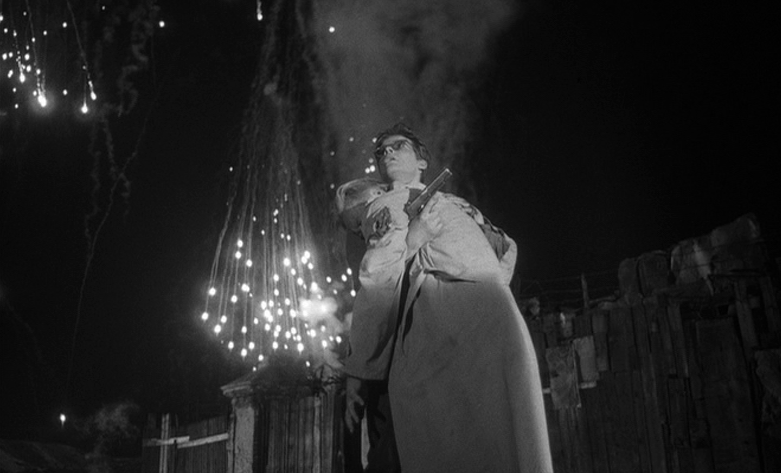
When viewing Ashes and Diamonds, it is obvious that Wadja watched many American films of the time, notably Citizen Kane. Wadja utilizes deep focus in ways similar to Wells and constantly uses low angles and shadowy surroundings to emphasize the action. The film's climax just looks stunning, as the action occurs as fireworks celebrating German surrender explode in the background. One would think that sequence would only truly work in color so we could see the bright lights of the explosions, but I don't think that's true after seeing it. The white sparks against the black sky and grey figures is such a captivating memorable image, especially with the tense long take delivering the film's narrative climax.
The film's strongest dynamic comes from its three leads. Maciek, the dreaming, relaxed, sunglass-wearing young man, falls in love and is quickly torn between his country and himself. Maciek shines in an early scene where he manipulates an old hotel clerk to give him a premium hotel room by discussing the old days of Warsaw, before the Uprising and destruction of most of the city. Maciek still has his eyes on using the old man, but is truly lost in the memories of the old city.
However, perhaps the most entertaining storyline regards the double agent, as he lets an old drunkard in to an exclusive government engagement, and likely loses his job in the ensuing chaos. Drewnowski, uptight and seen as stupid by Maciek and Andrzej, the senior officer, allows himself to celebrate the German defeat and is soon coaxed in to drinking heavily by an old dunk man. Drewnowski, while intoxicated, can no longer keep his double life separate, and causes a scene by insulting the lauded mayor and allowing the old man to flip over tables. He loses his job, but when drunk, he doesn't care. We never get to see his reaction when he comes to the next morning, but that is a great thing. We get to debate ourselves what he thinks. Is he upset? Relieved? The character is so well written it could go either way.
Wadja's film deserves to be seen more frequently. While it takes much from American cinema, cinema at a whole has taken much from it. It's loose structure, multitude of characters yet contained setting can be seen in many modern film, such as the work of Robert Altman. Ashes and Diamonds is a all around great film, whose influence is greater than its current recognition.
Monday, July 15, 2013
DO THE RIGHT THING (Spike Lee, 1989) and Trayvon Martin
With the events of the past few days involving the Trayvon Martin-George Zimmerman trial, it only feels natural to discuss this film, and what it implies for race in America, and what it really means in relation to the trial. I've already heard it mentioned in regards to the "Not Guilty" verdict, a comparison I believe is wholly inaccurate.
First, let's discuss the film's construction at a whole, trying to keep it spoiler free. Do The Right Thing, along with 12 Angry Men, uses heat in such a visible way to keep the tension high and rising that it is practically a character. People are quicker to anger, and speak more directly than they probably should. Lee's character Mookie walks around a Brooklyn neighborhood delivering pizza, trying to stay cool, physically and emotionally, as a minor protest is formed in front of Sal's pizzeria where he works, based on the race of the members of "the wall of fame."
Race rears its head in many ways- ownership of the neighborhood, interracial romances, and racial ownership of ideas. But as the film progresses, its clear that Lee sees the world as Asians, African-Americans, Hispanic, and etc. against the white community. Sure, like the United States, whites are outnumbered in the neighborhood, but they still hold the power. The have the businesses. They have the antique brownstones. The still are the the power. For the record, as a white man, I completely belive this is true, and is even more confusing recently than it ever is. Black culture has been for nearly 100 years the cool scene in America, yet those that dictate the in, the cool, and the now are mainly white, and are very influenced by the caucasian power.
The film builds as the heat rises in Brooklyn, and its climax falls just after sunset. A fight ends with police intervention and the murder of a young black man. Silence cuts through the street. Eyes are on Sal, who started the fight with racial slurs and insults. And then, Mookie, our relatable, likable, kindly hero, picks up a trashcan and hurls it through the window of the pizzeria- the crowd follows his action, and soon the pizzeria is a pile of ashes. Audiences are often repelled by the action, mainly because Mookie is the film's hero, and is definitely seen as a good person. But in the end of the day, its a pizzeria against a human life, and not just that, a human life that ended moments before, and one of Mookie's best friends.
And it saddens me to hear this iconic and poignant scene in cinema brought up with the Martin-Zimmerman verdict. There are superficial similarities- neither victim was truly innocent, but neither deserved to die. That's not even debatable in my mind. But now with the verdict? It is true Justice. We don't always get it. The world is a complicated place with complicated laws. I believe in the American Justice system, and it states that one must be guilty without reasonable doubt. There was doubt, twelve random citizens decided. And he is free.
And you may not like it. But what do you know? Really, how do you know about this case? You only know what you are told. The jury has received the details of the case undiluted, without any bias, and thus they possess better judgment than anyone else hearing months of opinionated releases. It is still devastatingly sad, but that is all.
Now, I hear people talk about Mookie throwing that trash can, and calling us to throw the trashcan at Zimmerman. Mookie's act was not meditated. There was barely a minute to think, and not months of nonsense reporting feeding him. People argue that Mookie threw the trash can to defend Sal and his sons, but I don't really buy that, not was that Lee's intentions. He threw the can in rage, plain and simple, and a rightful rage at that.
Mookie attacked a store, deciding that human lives were less important. But what are those advocating violence against Zimmerman promoting? They want others to suffer what they feel. They are saying Zimmerman is less important than Trayvon Martin, which is simply untrue. Mookie really did the right thing with his trashcan through the window of Sal's. But action against Zimmerman, or just in the name of Trayvon months later just to make one feel better is just wrong.
Friday, July 12, 2013
IL POSTO (Ermanno Olmi, 1961)- Coffee
Il Posto, a criminally overlooked film by criminally overlooked Italian director Ermanno Olmi is in a lot of ways the anti-Bicycle Thieves (a film I hope to discuss soon). While Di Sicca's acclaimed masterpiece shows the dehumanizing effects of being in deep poverty, Il Posto shows the dehumanization that goes with a life-long, steady job. Truthfully, there is much more I could say about this film, and hope to compare it directly to The Bicycle Thief (personally, my preferred title. It's amazing I could write just about the film's title!) and many other neorealist films soon, as I see it as a reaction against the themes of the movement.
However, this is actually an older essay of mine, which deconstructs a pivotal scene in the film. Hopefully, I will look at it on a wider scale (although this is still written with the rest of the film in mind, and is not a reading of a detached scene) and link it more closely to other films and related styles.
Ermanno Olmi’s 1961 film Il Posto deals with the themes of corporate dehumanization and loss of personal identity. The film follows Domenico, a young Italian man (who bears more than a passing resemblance to influential Czech writer Franz Kafka, which given the film's message and content, is just too perfect to be chalked up as an amazing coincidence), as he seeks to get a job in a large corporation. Near the middle of the film, Domenico is called in to speak with the corporate supervisor about his job. The corporation promised him a job, but he does not know of his position. Domenico's meeting with his supervisor is the first communication he has within the company. The meeting marks Domenico's official initiation into the company, and though the scene’s makeup and cinematography, Olmi reveals Domenico's future employment in the company, as well as the rest of his life.
As Domenico enters the office, he stands in front of the supervisors desk. He is not officially a part of the company, and is unsure what to do in the office. He looms over the supervisor, who is sitting down at his desk. However, as soon as Domenico sits down, he is a part of the company, and placed near the bottom of the pyramid, well below the supervisor. Domenico’s chair is much lower than the supervisor’s, showing great power the supervisor has over Domenico. Domenico’s chair is also at a peculiar angle. He has such little power in the corporation, that he is not even allowed to directly face the supervisor. However, the problem is not unique to Domenico. Behind the protagonist is a line of chairs pressed up against the wall. However, the wall, as well as the chairs, are at a forty-five degree angle from the desk. The corporation’s inequality applies not only to young adults just beginning their career like Domenico, but to very common worker in the corporation. Domenico will probably never be supervisor due to the corporations structural inequality.
Although Olmi makes clear through the film’s visuals that Domenico will most likely never rise to become a supervisor, Domenico seems to be unaware of that fact during this scene in the film. During the meeting, another employee enters the room near the back of the frame, and walks to the supervisor’s desk. His long walk is reminiscent of Domenico’s just minutes prior, when the protagonist walked the long, nondescript hallway alone to the supervisor’s office. The similar images further point to the fact that one’s position within the company never changes. The man hands the supervisor his coffee and walks away, leaving the supervisor alone in the foreground. The focus shifts to Domenico, sitting in the frame’s middle, staring at the supervisor drinking his coffee. Earlier in the film, Domenico goes into a coffee shop, where he is visibly uncomfortable and confused in the bustling environment, seemingly having no idea what to do while drinking his coffee. Now, Domenico watches the supervisor comfortably drink his coffee at a large desk in his own massive office. Domenico stares at the man drink his coffee for several seconds. Domenico aspires to be in his own office one day, comfortably drinking coffee delivered to him instead of ordering a cup in the shop and having to wait in line then move through the crowded shop to a seat. However, the supervisor and his coffee, representing Domenico’s dream, are out of focus for the office, symbolizing they are out of reach for Domenico.
Soon after the supervisor finishes his coffee, a woman enters and gives the supervisor a written excuse for being late to work. The supervisor briefly chastises her, telling her her children are old enough to take care of herself. Domenico, who is uninvolved in the conversation, is captured in a closeup. Domenico’s mouth is open, apparently deeply interested in the woman’s situation, and is turning his head in order to look at both subjects. Then, the supervisor returns the excuse to the woman, and his hand juts out of the foreground. The out of focus hand and paper block Domenico’s face. Momentarily, Domenico’s face is the peice of paper, representing his grim status within the corporation: Another faceless worker, without an identity. The fact that the paper is an excuse symbolizes Domenico’s sole purpose in the corporation: work. His identity is not only unimportant, but is also in a position to hurt the company, as the woman just did by being late to tend to her children. For the company, it would be best if Domenico had no personality at all.
Throughout a seemingly simple scene in Il Posto where Domenico is told he must temporarily work in another position until a job opens up in his field, Olmi reveals complex information about Domenico’s future through images. Domenico needs a job urgently, so his fate is working at the corporation, where he will have a decent paying job for life. However, Domenico must face inequality within the corporation, seemingly little possibility for a promotion, and an eventual loss of identity. These ideas greatly impact the message of Il Posto, turning a coming-of-age story into a grim prediction of a likely hopeless future.
Labels:
Bicycle Thief,
classic review,
neorealism,
Olmi,
republish,
theme analysis
Monday, July 8, 2013
STRANGER THAN PARADISE (Jim Jarmusch, 1984)
Its hard to describe Jim Jarmusch's 1984 film without using on fo the great cliches- "the shot heard around the world." Really, I don't know how else I can express the massive influence that Jarmusch created by its relaxed tone and plot, tearing down the cliches of Hollywood, breaking both the model of high-octane blockbusters and deep, twisted think pieces from the 70s.
Jarmusch's film is one of the most captivating interesting pieces of art ever made about boredom, a feeling pretty much everyone experiences. Willie, played by musician John Lurie (who also supplied the score), wanders the eerily empty streets of New York, Cleveland and a Florida suburb without anything to really do. He is eventually joined by his friend Eddie and his young foreign cousin Eva.
Essentially, it's a hang-out film, and a great one at that. They watch TV, play poker, go to the track, and watch old movies. They try anything to fill the time, and fail miserably at it. The film puts forth its message when Willie declares that despite his Slovakian background he is American- boredom is the American pastime. Eva does nothing in America, but eventually becomes content with it when she steals some food to impress her cousin. Eddie, a natural American, just wanders around for the most part. No one has a serious commitment, and the only employed one, Eva, can leave her job without notice.
Its easy to see how far Jarmusch's influence has spread. Just its black and white cinematography long, relatively static takes and soundtrack have been endlessly referenced and parodied. Just in general, the modern Indie film movement was born with Stranger Than Paradise. It is easy to see how mumblecore, talky Linklater-esque films, and modern arthouse cinema derives from Jarmusch's early work. Simply, the idea of making a film without effects, major production values, or a solid plot was appealing to young filmakers lacking funds and resources. They had ideas, but not the budget or the acting talent. Jarmusch's film has a amateur quality to it, where anyone could make it with their camera, but few could make a film so captivating, interesting, and downright excellent as Jarmusch.
Stranger Than Paradise's influenced by showing its viewers what one could do with lesser production values and a story that aids an idea, not the other way around. In a way, it was an open challenge to young filmakers, and to this day, they are accepting and treading in its footsteps, although they are forging their own paths.
Wednesday, July 3, 2013
IT HAPPENED ONE NIGHT (Frank Capra, 1934)
Screwball comedies, rarely produced today except those made exclusively as a tribute, were ushered into existence with the advent of sound cinema. In silents, they were practically impossible, as their largest asset is quick, snappy dialogue. Perhaps one of the early defining examples of the screwball comedy is Capra's Academy Award winning It Happened One Night. Not only is the dialogue quick, witty and just funny, it also focuses on a humorously off-beat couple, another mainstay of the genre.
Produced in the height of the Great Depression, the poor economy creeps its way into the film, although not overtly. Gable's streetwise, out of work journalist, Peter Warne, is the major link to the depression. He hitch-hikes, cons hotels, but still has a good heart, evident in his overall kind treatment of spoiled heiress Ellie Andrews, played by Claudette Colbert. Ellie has run away from her father after he blocked her marriage to stuffy aviator King Westly. Andrews faces the depression drained world alone, and quickly learns the harsh realities of America at that moment.
Her bags are stolen. People try to con her left in right, and several times she is nearly outed to the papers for the hefty reward. This is where the audience clearly sees the ugly head of the depression. But since it is a comedy, and an escapist one at that, the depression leaves just a shadow. Our heroic couple overcomes all obstacles thrown at them, and retain their spirit.
At first, Warne can barely stand Andrew's spoiled attitude, and she can barely stand his drunken rude behavior. But, of course, they learn to bond, and eventually fall in love. One of the most memorable features of the film is the vibrant supporting cast- Andrews's father, who constantly expresses a dry glee in her would-be-husband's misfortunes, a loud, annoying bus passenger who constantly tries to flirt with Ellie until Warne imitates a gangster who claims to have kidnapped her, making him shrink into a mouse, and a singing, goofy, yet thieving man who offers the mismatched couple a ride. The hilarious supporting cast shines, yet doesn't distract from the chief dynamic at play- the couple.
Andrews and Warne come to love one another, and learn off of one another. Warne softens, while Andrews hardens. However, of course, compilations soon arise, and the Andrews finds herself still in love with Warne, yet at home with her dull husband. Normally, the final act in romantic comedies, but here, it is still fresh- both characters love each other, but refuse to admit it, even to their face. Both go out of their way to hurl insults, but under pressure, admit their love.
It Happened One Night is a shining example of early sound studio filmmaking, and of the screwball comedy. Simply, it's escapist filmmaking at its best. Sure, audiences felt the depression lurking over the characters, but mainly saw how it didn't keep them down and they didn't even dwell on it. They had each other, and that, for them, was certainly enough.
Friday, June 21, 2013
A FACE IN THE CROWD (Elia Kazan, 1957)
Although I usually don't like to use the word "Underrated" regarding film, as it's incredibly overused as it is, Elia Kazan's 1957 film A Face in the Crowd certainly fits the criteria (or actually, "under viewed" might be a better fit. Although it receives acclaim now, Kazan's originally critically reviled film isn't seen as the classic it truly is.
The late Andy Griffith hypnotizes the audience as Lonesome Rhodes, a crazed, larger than life radio personality who takes the world by storm, only to use his huge, loyal audience for his own benefit and exploits them. Rhodes doesn't even exploit them for his own ideological gains- he seems too stupid and monetarily interested to have his own opinions.
Rather than a typical look at the film, I've decided to republish an older essay on Kazan's film, exploring the film's treatment of celebrity excess:
Elia Kazan’s 1957 film A Face in the Crowd stars Andy Griffith stars as Lonesome Rhodes, a drifter who a radio station hires to sing songs and spout “Grass root wisdom.” From his humble beginnings, Rhodes becomes a phenomenon with a rabid fan base and a national television program. Kazan uses his characters to show the realities of the media culture. Lonesome Rhodes represents the powerful, narcissistic, nearly unstoppable media, while his love interests represent the general public’s reaction to the media. A Face in the Crowd serves as a portrait of the media, the characters it creates and the general public’s reaction.
After being released from jail, Rhodes slowly begins to realize his impressive amount of power: first as an entertainer, then as a voice of the people and finally as a political figure. Rhodes’s power was always imminent on screen through his presence in the frame. When the audience is introduced to Rhodes, he is hungover, sleeping in the corner of the county jail. He is completely absent for the several minutes of the film, but after the sheriff wakes him, he immediately becomes the film’s focus.
Throughout the majority of the film, Rhodes occupies the middle of the frame, representing his massive personality and his unstoppable nature. If Rhodes is not in the center of the frame in the shot’s beginning, it seems he moves within the frame to become the literal center of attention. However, at the film’s end, Rhodes embarrasses himself on the air, mocking the audience, and forever loses his seemingly unstoppable power, as well as Marcia Jefferies, the woman he loves. The film’s final shot is of the New York City landscape: Taxis, skyscrapers, and a large neon Coca-Cola sign. The audience can hear Rhodes cry into the night, but he is nowhere to be seen: His celebrity has faded.
Rhodes’s relationship with the public is represented by two women he loves: Betty Lou Fleckum and Marcia Jefferies. Fleckum represents the mass public. Fleckum, who becomes Rhodes’s wife at age seventeen, is at first completely infatuated by him, even admitting to have a picture of Rhodes taped to her ceiling. However, Fleckum quickly looses interest and cheats on her husband after several months. Rhodes’s true love is Jefferies, who represents the more educated public. Jefferies, a radio producer, discovers Rhodes in jail, and planned to wed him, but Rhodes became hypnotized by the energetic passion of Fleckum.
Despite his betrayal, and her first hand knowledge of the artificiality and deep-rooted corruption of Lonesome Rhodes, Jefferies still loves him, and was unable to leave him until the film’s end. Jefferies directly causes Rhodes’s downfall, as she is responsible for leaking his off-air comments, where he calls the audience idiots. Jefferies felt that her and Rhodes could only be separate if she ruined his career. Like the public, Jefferies overlooked Rhodes’s unappealing behavior and focused on his status and power. Once his fame was diminished, Jefferies could leave. Ultimately, the power of media and celebrities transfixes the public and holds them captive until the glossy lights of fame are dimmed or removed.
Labels:
Classic Film,
classic review,
Griffith,
Kazan,
republish
Wednesday, June 19, 2013
LIFE IS SWEET (Mike Leigh, 1990)
Mike Leigh is an anomaly. It's rare for a director to be so acclaimed, yet receive so little mainstream recognition in America. Sure, Leigh gets a ton of recognition from the niche cinephile crowd, like the Criterion Collection, but Leigh's films have never had a major studio backing. Perhaps his films are just "too British" for America in many ways, full of dry wit, quirky characters, and dark moments of drama contrasting from the established tone.
Perhaps Life is Sweet is the finest example of Leigh's style, and his "British" touch, even though the film's has an decidedly American focus of a family trying to succeed and, in a word, follow their dreams. The father, Andy, is a successful head chef who buys a broken down food truck. His wife, Wendy, seems to be a housewife first and tries to pick up a career afterward. Their two twenty-two year old daughters appear to be polar opposites- Natalie is a neat, short-haired, focused plumber's apprenticed, while the frail Nicola appears to do nothing but sit around all day. Essentially, the parents want to move forward with their lives, while their daughters are content, one way or another.
The film is set in motion by Andy's brash decision to spend decidedly too much on a broken down food truck, drawing mockery and criticism from the rest of his family. Andy never really does much with the van, besides sleeping in it after a rough night at the pub. Based on his family life, Andy seems like a bumbling man-child, akin to a schlubby sitcom Dad. However, our perception of Andy is shattered when we see brief scenes of him working as a head chef- he has complete control of his kitchen. While his family life is not a total mess of dysfunction, it is certainly less sleek and streamlined than his kitchen. Andy's purchase of the truck is simply an attempt to come into his own, and truly have control of his own life, by owning a business. However, despite the impulsive purchase, Andy is slow to get started, planning and thinking practically.
Andy's slow, planned start greatly contrasts the food-business entry of family friend Aubrey, a young, showy, unintentionally goofy young man who seems to hide his great insecurity with inflated pride. Aubrey's chief characteristic appears to be frustration- both occupational and sexual. He lusts over both Wendy and Nicola, and loudly hammers on the drums when things do not go his way, to the mocking amusement of Andy and Wendy. While Andy begins to informally plan a menu, discussing a few food items the cart will serve, Aubrey had no planning it seems besides working off his presumed culinary genius. His food is incredibly unappetizing, as is the restaurant's decor. Aubrey's rush into the restaurant business is disastrous, as he forgets to advertise at all for the restaurants opening. Aubrey represents the dangers of unchecked dreaming without realism.
Wendy volunteers to be Aubrey's opening night waitress, adding to a string of odd jobs- child's dance instructor, baby clothes salesperson, and French cuisine waitress. However, Wendy is only seen at each of these jobs once, and she is mainly seen around her family, which is perhaps her true occupation in her eyes, even though she may resist it. As she reveals to Nicola towards the end, she originally had other plans for her life before becoming pregnant at a young age with twins. Her decision not to abort Nicola and Natalie alters her coure in life, although she, nor Andy, seem to regret their decision. Still, Wendy takes up small, quirky jobs as means to entertain and fulfill her still young spirit.
Of the twins, Nicola appears to be a complete mess, and the source of the biggest dramatic tension in the film. Nicola is bulimic, a fact Lehigh deals with seriously, but does not force down the audience's throats. Life is Sweet is certainly not an "issue film," like an after-school special, in this regard, biut simply is a film that, among other things, covers this topic seriously and without judgment. Nicola's bulimia is just another complication in her life and her personality- she's rude, unpleasant, and appears to be completely apathetic towards everything. Although she says she is political, she attends no rallies, does not write, and is completely non committal. In fact, when she criticizes her father for striving to be a capitalist, Wendy encourages her to join a socialist group, just so she can do something. Nicola also appears to care deeply for her unnamed lover, but tries to show no affection whatsoever. Even if she does not care for him, per say, she cares what he says and what he does. She constantly forces him to rub her down with Hazelnut spread, and then eat it off of her, relating back directly to her eating disorder, and despite blowing him off and acting disinterested, she seems heartbroken when he calls her stupid. Nicola's apathy has ruined her in a way, leaving her empty and aimless.
Natalie, on the other hand, appears a different kind of empty. She has a solid job with a plumber, and is constantly referred to as the "happy one." However, externally, Natalie shows no emotion, especially no signs that she is happy at all. In reality, she is not the "happy one," but simply the one who is much more emotionally stable. Besides her work, though, Natalie seems to have very little. She never mentions a boyfriend or lover, despite her plans to have a child soon. Natalie's emptiness is much more subtle than the rest of the family's, but possibly could be the most devastating she appears to have little besides a solid career, while everyone else has something- even Nicola learns how important her family is.
Life is Sweet paints a portrait of dysfunction, but does so lovingly and sincerely. Even calling it dysfunction doesn't seem right, but I currently lack a better term. Sure the family has issues, but most do. At the end of the film, they appear completely united by a small, lightly traumatic event- a simple broken leg. After fights, every member of the family renews their peace with one another. However, their occupational peace is interrupted- the food cart is on hold, Wendy will no longer work for Aubrey after he drunkenly came on to her, and Nicola still has no idea what she will do. But the family is together, and for them, and for the audience, that is really all that matters when the film closes. We focus not on the food truck, but on the family.
Perhaps Life is Sweet is the finest example of Leigh's style, and his "British" touch, even though the film's has an decidedly American focus of a family trying to succeed and, in a word, follow their dreams. The father, Andy, is a successful head chef who buys a broken down food truck. His wife, Wendy, seems to be a housewife first and tries to pick up a career afterward. Their two twenty-two year old daughters appear to be polar opposites- Natalie is a neat, short-haired, focused plumber's apprenticed, while the frail Nicola appears to do nothing but sit around all day. Essentially, the parents want to move forward with their lives, while their daughters are content, one way or another.
The film is set in motion by Andy's brash decision to spend decidedly too much on a broken down food truck, drawing mockery and criticism from the rest of his family. Andy never really does much with the van, besides sleeping in it after a rough night at the pub. Based on his family life, Andy seems like a bumbling man-child, akin to a schlubby sitcom Dad. However, our perception of Andy is shattered when we see brief scenes of him working as a head chef- he has complete control of his kitchen. While his family life is not a total mess of dysfunction, it is certainly less sleek and streamlined than his kitchen. Andy's purchase of the truck is simply an attempt to come into his own, and truly have control of his own life, by owning a business. However, despite the impulsive purchase, Andy is slow to get started, planning and thinking practically.
Andy's slow, planned start greatly contrasts the food-business entry of family friend Aubrey, a young, showy, unintentionally goofy young man who seems to hide his great insecurity with inflated pride. Aubrey's chief characteristic appears to be frustration- both occupational and sexual. He lusts over both Wendy and Nicola, and loudly hammers on the drums when things do not go his way, to the mocking amusement of Andy and Wendy. While Andy begins to informally plan a menu, discussing a few food items the cart will serve, Aubrey had no planning it seems besides working off his presumed culinary genius. His food is incredibly unappetizing, as is the restaurant's decor. Aubrey's rush into the restaurant business is disastrous, as he forgets to advertise at all for the restaurants opening. Aubrey represents the dangers of unchecked dreaming without realism.
Wendy volunteers to be Aubrey's opening night waitress, adding to a string of odd jobs- child's dance instructor, baby clothes salesperson, and French cuisine waitress. However, Wendy is only seen at each of these jobs once, and she is mainly seen around her family, which is perhaps her true occupation in her eyes, even though she may resist it. As she reveals to Nicola towards the end, she originally had other plans for her life before becoming pregnant at a young age with twins. Her decision not to abort Nicola and Natalie alters her coure in life, although she, nor Andy, seem to regret their decision. Still, Wendy takes up small, quirky jobs as means to entertain and fulfill her still young spirit.
Of the twins, Nicola appears to be a complete mess, and the source of the biggest dramatic tension in the film. Nicola is bulimic, a fact Lehigh deals with seriously, but does not force down the audience's throats. Life is Sweet is certainly not an "issue film," like an after-school special, in this regard, biut simply is a film that, among other things, covers this topic seriously and without judgment. Nicola's bulimia is just another complication in her life and her personality- she's rude, unpleasant, and appears to be completely apathetic towards everything. Although she says she is political, she attends no rallies, does not write, and is completely non committal. In fact, when she criticizes her father for striving to be a capitalist, Wendy encourages her to join a socialist group, just so she can do something. Nicola also appears to care deeply for her unnamed lover, but tries to show no affection whatsoever. Even if she does not care for him, per say, she cares what he says and what he does. She constantly forces him to rub her down with Hazelnut spread, and then eat it off of her, relating back directly to her eating disorder, and despite blowing him off and acting disinterested, she seems heartbroken when he calls her stupid. Nicola's apathy has ruined her in a way, leaving her empty and aimless.
Natalie, on the other hand, appears a different kind of empty. She has a solid job with a plumber, and is constantly referred to as the "happy one." However, externally, Natalie shows no emotion, especially no signs that she is happy at all. In reality, she is not the "happy one," but simply the one who is much more emotionally stable. Besides her work, though, Natalie seems to have very little. She never mentions a boyfriend or lover, despite her plans to have a child soon. Natalie's emptiness is much more subtle than the rest of the family's, but possibly could be the most devastating she appears to have little besides a solid career, while everyone else has something- even Nicola learns how important her family is.
Life is Sweet paints a portrait of dysfunction, but does so lovingly and sincerely. Even calling it dysfunction doesn't seem right, but I currently lack a better term. Sure the family has issues, but most do. At the end of the film, they appear completely united by a small, lightly traumatic event- a simple broken leg. After fights, every member of the family renews their peace with one another. However, their occupational peace is interrupted- the food cart is on hold, Wendy will no longer work for Aubrey after he drunkenly came on to her, and Nicola still has no idea what she will do. But the family is together, and for them, and for the audience, that is really all that matters when the film closes. We focus not on the food truck, but on the family.
Labels:
Classic Film,
classic review,
Leigh,
review,
UK film,
World FIlm
Thursday, June 13, 2013
NIGHT OF THE HUNTER (1955, Charles Laughton)
Just as a note, "classic" reviews will lean more towards analysis, and be more liberal with spoilers.
Towards the end of his stories career, world renowned actor Charles Laughton turned to directing, leading stage productions of Caine Mutiny Court Marshall and Don Juan in Hell, receiving critical acclaim. It was then only natural that Laughton should move into film direction, and did so with 1955's Night of the Hunter. The film suffered from poor contemporary reviews, and Laughton never directed another film.
It is fairly easy to see why Night of the Hunter was critically panned at the time. In a word, the film is just bizarre, featuring heavily stylized performances, unusual pacing, and direct addresses of the camera. But for these reasons, Laughton's film acts as an important milestone in American cinema, and widely influenced future filmmakers, notably David Lynch.
At the core, the film is a story of good and evil, but Laughton's script, which he co-wrote with David Agee, presents the story like a fable, where Robert Mitchum's corrupt preacher is not just evil, but represents evil at a whole, while Lillian Gish's Mrs. Cooper stands for an ultimate good. Mitchum is spectacular as the singing, tattooed, ever-present con-man claiming to be a man of God (and seems to genuinely believe he is a man of God), who feels his mission is to murder "loose" widows and make off with their money. He arrives at the Harper household shortly after the father's execution for robbery, and Powell sets himself to find the money he believes the dead man hid with his children.
The stark photography aids the black-and-white morality the fable-like film creates, with high contrast throughout and heavy use of shadows and motivated lighting. Powell lives in the shadows it seems, and when the children flee, he searches for them and their money day and night. But ultimately, evil has no chance in the world of the film. Powell seems to be completely incompetent, and is unable to do harm with any opposition from good characters. He trips over glass jars, gets his fingers slammed in the door, is unable to swim, and ultimately, Gish's Mrs. Cooper accidentally shoots him when both are startled by a cat. When he's shot, Powell shrieks like Daffy Duck, showing that in the end, he's just an animal, capable of harm but easy to defeat if one is aware of him. Cooper calls the police, saying that an animal is trapped in her barn. When they leisurely arrive several hours later, Powell is still in the barn, at this point too cowardly to even attempt an escape.
Despite his quick disposal, the audience truly believes Powell is a serious threat. When he arrives at Mrs. Cooper's house near the end of the film, singing his favorite hymn, it's once again blood-curdling. At that moment, he seems so intimidating and icy, one forgets how useless he was chasing the children just minutes earlier. However, one does not forget his psychological manipulation of the widow, Willa (Shelly Winters), and the Spoons, a naive, yet kind couple that befriended the Harpers.
Willa at first seems uninterested in Powell, as she mourns her husband's death, but soon she believes that Powell is the key to her salvation and freedom from sin. She quickly marries Powell, and on the first night attempts to sleep with him, though Powell chastises her, and eventually indoctrinates her into his fanatical mindset. In a brillant sequence, Willa and Powell preach at a church lit by torches. One torch always engulfs the left hand corner of the screen, seemingly unmoving from shot to shot. Willa eventually learns that Powell is after her husband's money, but does not seem overly concerned. Nevertheless, Powell acts quickly, and slits her throat as she lies in bed, disinterested in her surroundings.
The Spoons support Powell tirelessly, giving him the unconditional benefit of the doubt. After he murders Willa, Powell cries to the Spoons, who mock Willas's "loose morals," and remain completely unsuspicious, even when Powell insists that there is no way WIlla could possibly return, and when Powell disappears. Yet at the film's end, when Powell is convicted and set to be executed, the Spoons lead an angry mob, with literal pitchforks, to the prison to lynch Powell. At this moment, the Spoons are both outraged and embarrassed that Powell operated directly under their noses. Yet they do not mention their guilt of inaction, only demonize the preacher and lead a crowd in pitying the Harper children,
The film also has several interesting points to make on religion. Religion is seen at both its best and its worst though Powell and Cooper. Powell is simply a fanatic who has lost all sight of the religion's true meaning. He does not commit to any religion, and seems to create one which aids his own needs, to the point where he believes that his personal lord sends him to widows. John Harper, the dead man's son who constantly clashes with Powell, is repulsed by Powell's fanaticism, and is the only character who can see through his nonsense immediately. Mrs. Cooper, on the other hand, is certainly Christian and routinely reads the children stories from the bible. When she first attempts to read to the children about Moses, John leaves the room in disgust, but slowly turns his head towards Mrs. Cooper in order to hear the story.
The beliefs of Powell and Cooper come head to head during the films climax, where the two sing their own versions of "Leaning on the Everlasting Arms." Cooper's specifically mentions Jesus, something Powell has failed to do the entire film. Sure, he mentions "the Lord" regularly, but the reference is so unspecific and vague, it could mean anything. Powell's true religion is simply a self-serving one.
Some of the film's abstract themes and techniques have heavily influenced other filmmakers. The Coen Brothers, notably their early films (but one could easily make a case tying Night of the Hunter to their masterpiece No Country for Old Men), utilized heavily stylized performances to depict larger themes, like the demonic biker in Raising Arizona. The film allegorically uses nature to reflect the themes of the film, which has evolved to be a staple in the filmography of Terrence Malick David Lynch used many of the film techniques, notably borrowing the film's opening, where Cooper adresses the audience in the cosmos, for the ultimate scene in The Elephant Man.
Night of the Hunter, while being widely influential, is completely capable of standing on its own merits as a poetic film acting very much as a modernized fairy tale, where children triumph, good exposes evil as weak and even silly, and evil is punished. Through the years, the film has gained significant praise, reversing the early poor reviews. However, it is certainly easy to understand why 1955 audiences would have been taken aback, even repulsed, by the film's odd delivery and style.

Towards the end of his stories career, world renowned actor Charles Laughton turned to directing, leading stage productions of Caine Mutiny Court Marshall and Don Juan in Hell, receiving critical acclaim. It was then only natural that Laughton should move into film direction, and did so with 1955's Night of the Hunter. The film suffered from poor contemporary reviews, and Laughton never directed another film.
It is fairly easy to see why Night of the Hunter was critically panned at the time. In a word, the film is just bizarre, featuring heavily stylized performances, unusual pacing, and direct addresses of the camera. But for these reasons, Laughton's film acts as an important milestone in American cinema, and widely influenced future filmmakers, notably David Lynch.
At the core, the film is a story of good and evil, but Laughton's script, which he co-wrote with David Agee, presents the story like a fable, where Robert Mitchum's corrupt preacher is not just evil, but represents evil at a whole, while Lillian Gish's Mrs. Cooper stands for an ultimate good. Mitchum is spectacular as the singing, tattooed, ever-present con-man claiming to be a man of God (and seems to genuinely believe he is a man of God), who feels his mission is to murder "loose" widows and make off with their money. He arrives at the Harper household shortly after the father's execution for robbery, and Powell sets himself to find the money he believes the dead man hid with his children.
The stark photography aids the black-and-white morality the fable-like film creates, with high contrast throughout and heavy use of shadows and motivated lighting. Powell lives in the shadows it seems, and when the children flee, he searches for them and their money day and night. But ultimately, evil has no chance in the world of the film. Powell seems to be completely incompetent, and is unable to do harm with any opposition from good characters. He trips over glass jars, gets his fingers slammed in the door, is unable to swim, and ultimately, Gish's Mrs. Cooper accidentally shoots him when both are startled by a cat. When he's shot, Powell shrieks like Daffy Duck, showing that in the end, he's just an animal, capable of harm but easy to defeat if one is aware of him. Cooper calls the police, saying that an animal is trapped in her barn. When they leisurely arrive several hours later, Powell is still in the barn, at this point too cowardly to even attempt an escape.
Despite his quick disposal, the audience truly believes Powell is a serious threat. When he arrives at Mrs. Cooper's house near the end of the film, singing his favorite hymn, it's once again blood-curdling. At that moment, he seems so intimidating and icy, one forgets how useless he was chasing the children just minutes earlier. However, one does not forget his psychological manipulation of the widow, Willa (Shelly Winters), and the Spoons, a naive, yet kind couple that befriended the Harpers.
Willa at first seems uninterested in Powell, as she mourns her husband's death, but soon she believes that Powell is the key to her salvation and freedom from sin. She quickly marries Powell, and on the first night attempts to sleep with him, though Powell chastises her, and eventually indoctrinates her into his fanatical mindset. In a brillant sequence, Willa and Powell preach at a church lit by torches. One torch always engulfs the left hand corner of the screen, seemingly unmoving from shot to shot. Willa eventually learns that Powell is after her husband's money, but does not seem overly concerned. Nevertheless, Powell acts quickly, and slits her throat as she lies in bed, disinterested in her surroundings.
The Spoons support Powell tirelessly, giving him the unconditional benefit of the doubt. After he murders Willa, Powell cries to the Spoons, who mock Willas's "loose morals," and remain completely unsuspicious, even when Powell insists that there is no way WIlla could possibly return, and when Powell disappears. Yet at the film's end, when Powell is convicted and set to be executed, the Spoons lead an angry mob, with literal pitchforks, to the prison to lynch Powell. At this moment, the Spoons are both outraged and embarrassed that Powell operated directly under their noses. Yet they do not mention their guilt of inaction, only demonize the preacher and lead a crowd in pitying the Harper children,
The film also has several interesting points to make on religion. Religion is seen at both its best and its worst though Powell and Cooper. Powell is simply a fanatic who has lost all sight of the religion's true meaning. He does not commit to any religion, and seems to create one which aids his own needs, to the point where he believes that his personal lord sends him to widows. John Harper, the dead man's son who constantly clashes with Powell, is repulsed by Powell's fanaticism, and is the only character who can see through his nonsense immediately. Mrs. Cooper, on the other hand, is certainly Christian and routinely reads the children stories from the bible. When she first attempts to read to the children about Moses, John leaves the room in disgust, but slowly turns his head towards Mrs. Cooper in order to hear the story.
The beliefs of Powell and Cooper come head to head during the films climax, where the two sing their own versions of "Leaning on the Everlasting Arms." Cooper's specifically mentions Jesus, something Powell has failed to do the entire film. Sure, he mentions "the Lord" regularly, but the reference is so unspecific and vague, it could mean anything. Powell's true religion is simply a self-serving one.
Some of the film's abstract themes and techniques have heavily influenced other filmmakers. The Coen Brothers, notably their early films (but one could easily make a case tying Night of the Hunter to their masterpiece No Country for Old Men), utilized heavily stylized performances to depict larger themes, like the demonic biker in Raising Arizona. The film allegorically uses nature to reflect the themes of the film, which has evolved to be a staple in the filmography of Terrence Malick David Lynch used many of the film techniques, notably borrowing the film's opening, where Cooper adresses the audience in the cosmos, for the ultimate scene in The Elephant Man.
Night of the Hunter, while being widely influential, is completely capable of standing on its own merits as a poetic film acting very much as a modernized fairy tale, where children triumph, good exposes evil as weak and even silly, and evil is punished. Through the years, the film has gained significant praise, reversing the early poor reviews. However, it is certainly easy to understand why 1955 audiences would have been taken aback, even repulsed, by the film's odd delivery and style.
Labels:
Classic Film,
classic review,
Coen,
Elephant Man,
Gish,
Lynch,
Malick,
Mitchum,
Night of the Hunter,
Raising Arizona,
review
Subscribe to:
Posts (Atom)