Showing posts with label Linklater. Show all posts
Monday, July 8, 2013
STRANGER THAN PARADISE (Jim Jarmusch, 1984)
Its hard to describe Jim Jarmusch's 1984 film without using on fo the great cliches- "the shot heard around the world." Really, I don't know how else I can express the massive influence that Jarmusch created by its relaxed tone and plot, tearing down the cliches of Hollywood, breaking both the model of high-octane blockbusters and deep, twisted think pieces from the 70s.
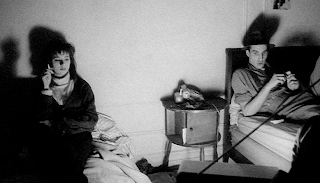
Jarmusch's film is one of the most captivating interesting pieces of art ever made about boredom, a feeling pretty much everyone experiences. Willie, played by musician John Lurie (who also supplied the score), wanders the eerily empty streets of New York, Cleveland and a Florida suburb without anything to really do. He is eventually joined by his friend Eddie and his young foreign cousin Eva.
Essentially, it's a hang-out film, and a great one at that. They watch TV, play poker, go to the track, and watch old movies. They try anything to fill the time, and fail miserably at it. The film puts forth its message when Willie declares that despite his Slovakian background he is American- boredom is the American pastime. Eva does nothing in America, but eventually becomes content with it when she steals some food to impress her cousin. Eddie, a natural American, just wanders around for the most part. No one has a serious commitment, and the only employed one, Eva, can leave her job without notice.
Its easy to see how far Jarmusch's influence has spread. Just its black and white cinematography long, relatively static takes and soundtrack have been endlessly referenced and parodied. Just in general, the modern Indie film movement was born with Stranger Than Paradise. It is easy to see how mumblecore, talky Linklater-esque films, and modern arthouse cinema derives from Jarmusch's early work. Simply, the idea of making a film without effects, major production values, or a solid plot was appealing to young filmakers lacking funds and resources. They had ideas, but not the budget or the acting talent. Jarmusch's film has a amateur quality to it, where anyone could make it with their camera, but few could make a film so captivating, interesting, and downright excellent as Jarmusch.
Stranger Than Paradise's influenced by showing its viewers what one could do with lesser production values and a story that aids an idea, not the other way around. In a way, it was an open challenge to young filmakers, and to this day, they are accepting and treading in its footsteps, although they are forging their own paths.
Monday, July 1, 2013
BEFORE MIDNIGHT (Richard Linklater, 2013)
Before Midnight, likely the final film in an outstanding romantic trilogy by off-beat auteur Richard Linklater, resembles Linklater's other films more than it resembles its predecessors- Before Sunrise and Before Sunset. Jesse and Celine are certainly at the forefront, but Linklater focuses more on other characters than the two lovers, like his sprawling, open films like Slacker, Dazed and Confused, and Waking Life, just to name a few.
As a result, the first act begins to lag (after two scenes, involving a Jesse dropping his son off, and a long drive back to their Greek country house). Personally, Linklater's writing style- involving multiple characters dropping huge words and "inherent truths" and philosophies comes off as pseudo-intellectual and simply full of itself. The characters say all they want, but they don't really mean anything. Although the scene where Jesse discusses concepts for a novel is at least interesting, albeit slightly overdone, the following segment involving a table full of Linklater stock characters discussing love and relationships seems to go on forever and drys up an momentum the film had. Jesse and Celine eventually leave on their own, and essentially, must rebuild the film's tone.
However, they certainly do so quickly, as Before Midnight recovers as Jesse and Celine walk the streets of Greece, in a scene that instantly recalls the earlier two films. For the first time, the two are truly alone, and are now back on the streets of Europe, where we first saw them twenty years ago. The couple arrives at their hotel, at which point the film's tone slowly shifts from the relaxed discussion recalling the first two films to an emotionally intense hour of name called, secrets, accusions, and a total lack of rationality.
Truthfully, I really don't want to spoil anything. However, I need to point out the conflict of gender the film puts forward. I'm sure 90% of men will sympathize with Jesse as he tries to combat the "Mayor of Crazy Town," while I think most women will realize Celine's concerns and how quickly Jesse rebuffs them. The film itself drops its viewers into the argument and almost forces them to take sides.
Before Midnight blossoms into a very good film, although not rising to the spectacular heights of the original film from 1995. All three are exceptional, but the first and the last are clearly the strongest- perhaps because they capture a definitive period of time. Sunrise is youth, where we do not care to look into the future, while in the middle age of Midnight we must. Sunset is the odd transition period, where it is really only clear to us that this is a permanent change, and the characters do not. Perhaps the reason I prefer the first film is because of my age- at 20, I relate much more towards the young, idealistic Jesse and Celine, who refuse to exchange numbers out of the principal, not realizing the heartbreak it will cause in the future. In Midnight, they must truly break down their idealism and address their true desires.
Subscribe to:
Posts (Atom)
