Showing posts with label film. Show all posts

Wednesday, July 24, 2013

The growing distance between film and television


       Television, with the birth of original, in-depth programming such as Breaking Bad, has been seen as a more artistic and in depth story telling medium than ever before. Content is riskier and freer than what broadcast television could ever offer. Shows can now tell completely inter-connected stories without trying to bring in new viewers week after week. Now, with the internet, viewers can get caught up to date on their own time.
       Some even argue that television is the new place to tell in-depth dramatic stories, and film is becoming a mix of two extremes- low-budget indies, and high-budget popcorn fare. Studios no longer want to take the risk on higher budget dramas, and the public suggests that television is the place to tell them. If Game of Thrones was published ten years earlier, it would likely be a movie series. To many, television is the medium to tell new dramatic stories. It makes sense in a way- you can obviously go so much more in depth by telling a story over twelve hours than in two or three.
       Now, I don't mean to generalize here- there have been some great higher budget dramatic films in the last few years, such as Lincoln, and the superiority of television is a pretty controversial opinion, even though many serious writers now swear by it. People seem to want to write for TV much more than film today, and see it as not only either to get into, but more exciting and free to work for.
       Film, to me at least, is more effective than television because of its brevity. The longest of (commercial) films run about 3 hours. Every frame holds so much power and meaning. Stories must be completely fulfilling within the small time frame, while an episode of a TV show must complete a small arch but is expected to leave many answers that can be picked up on. Sure, some films have sequels, but usually they are unexpected and only leave a few questions.
       Film, I also argue, is most certainly freer. A single 2-hour film can be made much cheaper than a small run of episodes for a television show that will garner serious attention. Film, when made on a small budget or with total freedom, can be much more experimental and adventurous. Television, I believe, will always be narrative. There will likely never be an experimental television show, and Television's modern rebirth simply means telling much more adults plots, like those on The Sopranos and Breaking Bad.
       In a lot of ways, the brevity and smaller scale (which lends to freedom) of film can never be replicated in an episodic television show, at least in its typical format that can be expanded upon for years and years. Mini-series are an entirely different case, like Fassbinder's Berlin Alexanderplatz, but there could never be a Season two of something as sprawling and unusual as that. As great as something like Breaking Bad, The Sopranos, or The Wire, I don't think its even possible to compare it to a two or three hour film. I won't say one is better than another, but simply different, and as a writer and filmmaker myself, I feel more comfortable and free working within a time frame that forces a critical exclusive editing process as intense as a film screenplay and feature film. Obviously, this is just an opinion, but I assert that the two mediums are simply incomparable, and their only shared similarity is that they are watched on the same screen.

Friday, July 5, 2013

Film Education


        Film is over one hundred years old at this point. This isn't just the creation of the medium, but the creation of the formal language that is film. However, few have a firm grasp on film. Sure, nearly everyone watches the latest blockbusters, but everyone gets film in some way- TV, commercials, just simple videos online. And now, with the internet, video is all around us, yet we really don't understand it any more than people did fifty years ago, and not even that much more than one hundred years.
       Perhaps that is one of the joys of film- the fact that it is an ultimate escape. You understand it all, understand the movement of time and editing as it is presented to you. You know that it can cut and resume in an entirely different place at an entirely different time. But is simple basic literacy enough? Film can go so much deeper than basic narratives, and can be picked apart and analyzed, like literature.
       Which brings me to the main comparison and point: There should be a greater movement to teach film education, like there is to increase literacy and literary appreciation. Film is all around us, and to understand it, we must know more about it. We must know its history, its uses, and its dangers. We must understand how it can be manipulated and how it can communicate ideas through complex cinematography and editing. We must learn how to understand filmic devices, like various types of montage, and how to analyze them and pull the author's intentions out.
       That is what we learn in English classes. Sure, we write daily, so we must know how to write, and how to interpret writing, but now, many important messages are conveyed through film and videos. While making film is not needed, understanding and comprehension is.
       Many documentaries, especially political ones, and topical drama films use filmic language to manipulate the audience into buying the message presented. This is also used in literature, and while it occasionally finds success, tricking audiences is much easier with film, which is ironic in a sense since in literature you are only required to show words, while film requires so much more input  However, every aspect can be subtly manipulated, allowing the author to convey his point with ease and keep audiences in the dark in regards to the attention.
       And so we are taught how to read critically. Another aspect of literary education is quality. People generally read good books. Sure, someone's going to throw a jab in about Twilight or Fifty Shades but that is a different mission. Books like that are not made with the same intention as acclaimed best sellers, and that's perfectly fine. However, I can't honestly say the majority of the most successful films are good. A large part of the reason is, and I'm really trying not to sound like a total fuck right here, is that they simply don't know better. Now, I'm not saying everything is a piece of shit and people are idiots, but I honestly believe the majority of audiences don't realize what films can do. They can do so much more than tell a simple narrative story, which most do. Sure, I love narrative film, but it is perhaps at its most interesting when it toys with the concept of story and works outside of that. Experimental(ish) literature has found great success, while experimental film has mainly received public backlash.
       Sure, some people love experimental films, but most don't get them at all. And that's fine, but perhaps the best use is blending it with narrative and conventional film language. Literature that "thinks outside the box is rewarded and publicly well received because a wider audience gets it, due to literary education. If you teach people how to understand written words, but not how to read they will fall back on primitive stories, not knowing how else to communicate. And that is where film currently is.
       However, the medium is still very young. The first stylistic works are about 100 years old, like the 1913 Student of Prague, which a still is shown from above. I'm not saying that the artform is dead, or decrepit  or dried up, or anything of that sort. In fact, I'm saying the opposite. I'm saying that it's so young that there's so much more to be discovered. We can understand much more. Film's language will become much more complex and its history much more dense. An exciting time awaits us. However, education is essential in the advancement of anything. People must know in order to create. And perhaps that has never been more true than in film.

Friday, June 14, 2013

Great Responsibilities- the eventual death of superhero movies


       We have not seen a year without superhero movies since 2001. Since then, we have seen nearly every superhero have a franchise of their own, and several have had multiple franchises. And as of 2013, there is no end in sight. The end (at least for the time being) must be on the horizon. Film is suffering, audiences are suffering, and studios are setting themselves up for suffering- they might just not know it yet.
       The films themselves are weakening substantially. After The Avengers pioneered a sort of superhero extravaganza, which was incredibly entertaining, yet felt cheap, almost worthy of a two-hour special on ABC with all of the "special guest stars" and cheap narrative tricks, there is no new ground for superhero movies to develop. There are only so many ways to explore the consequences of a "great responsibility," and every angle has been explored multiple times in just the past five years. Good or evil, action or inaction, showmanship or humility, and countless more have been completed milked dry.
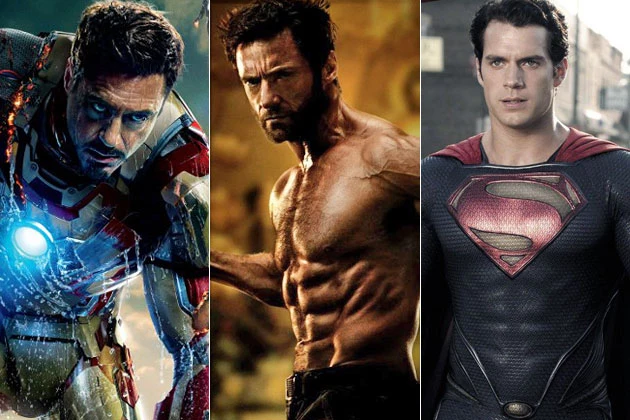
     Additionally, the films essentially are in two camps- the Marvel films, generally created for "cheap" action but packed with thrills and laughs (the Iron Man model), and the DC films, meant to serve "adults as well as children," lacking the humor  of comic books and attempted to dwell on deeper themes (the Dark Knight model). Man of Steel, released nationwide today, appears to conform to the latter model, but since I have not seen it yet, I can't comment on it. However, both models have serious downfalls.
      Marvel films are certainly more child-geared, which in itself isn't a bad thing, especially for the studios. They make boats of money, which more adult films cannot do. As a result, more adult-oriented films fail to receive studio backing, with the exception of those with Scorsese-like names attached. The Marvel films are the lesser problem. The Dark Knight model films deceive audiences, tricking adults into thinking that they are seeing a deep, thought-provoking film, when in reality they are seeing an action movie with "deep" themes tacked on top so clumsily, you can see the teeth marks made when the tape was ripped off the roll.
      Most adult audiences want both entertainment and stimulation, and the Dark Knight model films claim to offer both. But ultimately, the line between Iron Man model and Dark Knight model films is so vague, the same film is produced again and again. Last year's disastrous Amazing Spider-Man is the prime example. Not only has every theme explored in the film a carbon copy of Sam Rami's original work, it attempts to mesh the popcorn, neon-lit action of Iron Man with the foggy morals of Dark Knight, resulting in a total mess of a production. The film received a good share of praise, creating fear for the future of superhero movies. If meshing the two tones works, shouldn't that be the new norm- candy-coating action and brooding in one product?
      We are moving towards an atonal superhero movie, and the eventual crash of the genre. Perhaps the  film most likely to crash and burn is Justice League, with its needed massive budget, its handling of two "deeper" franchises- Man of Steel and the Dark Knight- and its promise of a mess of characters. If the genre does not fail, the films will certainly become less unique, and degrade to a cookie cutter formula. Already, there is very little new ground to explore in the genre. Over time, new areas will be created by the changing world, and superheros will be needed again, but the genre will soon be in a sad state.
     But will anyone notice the films are stale when they truly become the same thing over and over again, or will people flock to see a new version popular hero, even though the story and delivery is nearly identical to the last one? If the studios don't soon learn with the box office, they may never. We could be facing a grim few years cinematically, with studios willing to support originality less and less, relying on the safe, boring profits of the heros.

Edit: Just to clarify, I am speaking on adaptations of traditional superhero comic books. A History of Violence, Road to Perdition, and Ghost World are based on comics, but are able to really become their own, while I don't think Iron Man or Batman ever does. I'm sure there's a good amount of people who have no idea History of Violence is based on a comic, while even more obscure superhero comics can never break from their source material and become their own product.